
Clover Ground Cover
Most people arrive here with a plant already in mind. The useful question is whether it suits your spot — and three quick tests answer it.

Sizing
Size the spot, then test it
Add a row per area and give each its own product — the sunny strip, the shaded corner, the walked line each get a different right answer. Every bag is sized from its product page’s coverage table.
Not sure about the sun? The next section takes thirty seconds.
The three tests
Three tests for any spot
Ground cover fails for one of three reasons, and all three are measurable before you spend anything.
Sun — five checks
Pick a clear day. Look at the spot at 9am, 11am, 1pm, 3pm and 5pm. Count the checks where direct sunlight lands on the ground — not brightness, not filtered light. Multiply by two.
Do it in the season you plan to sow. Under deciduous trees, a spot with five hours in April can be at two by July.
Traffic — count crossings
Not “will people walk on it” — count how many times a day someone actually crosses. Twice a week and four times a day are different plants entirely.
Be honest about the desire line. If there is a route people take because it is the shortest way to the bins, they will keep taking it whatever you plant.
Soil — squeeze a handful
Take a damp handful and squeeze it.
| What it does | Soil | What it means |
|---|---|---|
| Holds its shape, feels slick | Clay | Slow drainage. Rules out thyme and Sagina unless amended |
| Falls apart immediately | Sand | Sharp drainage. Ideal for thyme, harder for clover |
| Holds loosely, then crumbles | Loam | Anything works |
| Gritty with stones through it | Rocky | Better than it looks — thyme and sheep fescue thrive |
What your three answers mean
| Sun | Traffic | What works |
|---|---|---|
| Under 2h | any | Moss only. No seed germinates below two hours |
| 2–4h | light | Fine fescue · Pennsylvania sedge · dry-shade mixes |
| 2–4h | daily | Nothing. See below |
| 4–6h | light | Micro clover · white clover · clover-grass mixes |
| 4–6h | daily | High-traffic clover and ryegrass mixes |
| 6h+ | light | Creeping thyme · flowering lawn mixes |
| 6h+ | daily | Elfin thyme · steppable path mixes |
| Zones 7–10, warm | any | Dichondra |
Before you buy
Why ground cover fails
Wrong plant for the light
The most common error by a wide margin, and the reason this page starts with a sun test. People choose by appearance, plant something needing six hours in four, and conclude the seed was poor. The failure is usually slow — the plant germinates, looks acceptable for a season, then thins. By the time it is obviously wrong, the cause is forgotten.
Fix: measure first. Every product we sell states a minimum sun requirement.
Wrong plant for the traffic
Moss looks like a lawn and is not one — “light-traffic only; daily wear thins it.” Creeping thyme takes light footfall and thins under a daily route. Fine fescue handles light to moderate and is not a sports surface.
Fix: count the crossings and match honestly. If there is a genuine path, plant the path properly rather than hoping ground cover will survive being one.
Wrong plant for the climate
Eight of the nine climate failures across our entire catalogue are the same thing: a cool-season species in Zone 8 or above. Fine fescue goes semi-dormant in summer heat above Zone 7b; buffalograss and prairie natives fail in the humid Northeast.
Fix: check your zone. The answer in Zone 9 is genuinely different from the answer in Zone 5.
The one we cannot fix: some spots suit no ground cover at all
Deep shade with daily traffic. A dog run along a fence. A slope over about 25%. Ground between pavers narrower than an inch. Soil compacted to the point where a fork will not enter it. These are paving, gravel or mulch decisions. No seed on the market changes them, and the most useful thing we can do is say so before you spend a season finding out.
The plants people search for
Creeping thyme — 6+ hours, sharp drainage
Most people arrive wanting creeping thyme; more yards can actually keep clover. Here is when each works, and — more usefully — when it does not.
ThymeWalk · $6.99 / 62 sq ft → $91.99 / 1,250 sq ft · from $74 per 1,000 sq ft.
“Thrives in the sharp drainage and heat of rock garden conditions. Very drought tolerant. Dense mat suppresses weeds and anchors soil.”
Works: full sun, sharp drainage, light foot traffic, sunny slopes, rock gardens, between stepping stones, fire-defensible space. Stays at 2–4 inches without mowing and flowers purple-pink May to July.
Does not work: shade, wet ground, daily traffic, rich irrigated soil.

Micro clover and clover mixes — 3+ hours
MicroTurf · clover with a fine fescue base · from $35 per 1,000 sq ft.
“A no-mow lawn mix that looks and functions like a conventional grass lawn. MicroClover stays invisible at mowing height. Mow 0–2 times per year or leave entirely.”
Works: three hours upward, most soils, moderate traffic, and it feeds itself — clover fixes roughly 100 lb of nitrogen per acre per year.
Does not work: below three hours, or if you intend to keep fertilising. Feeding it grows grass that outcompetes the clover.
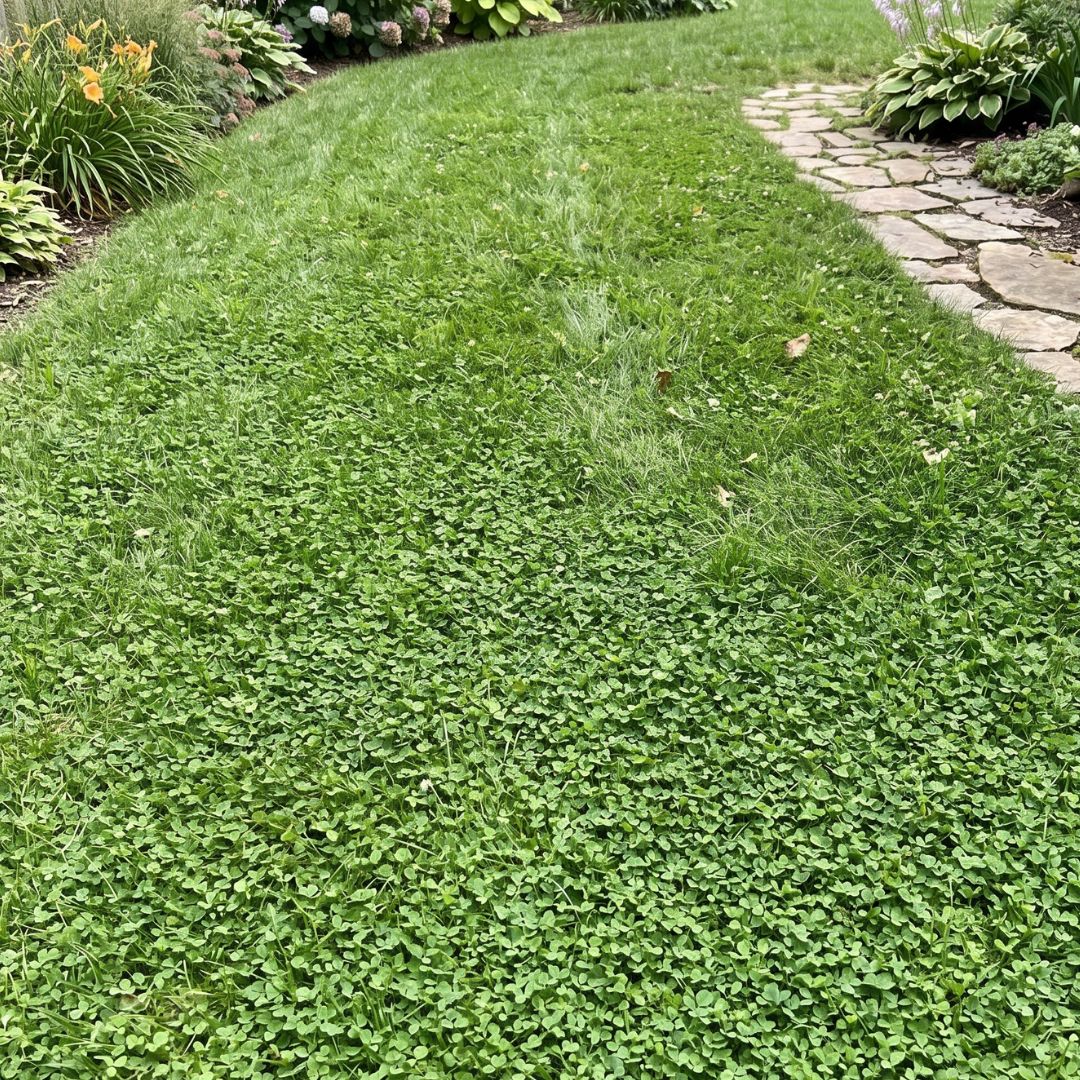
Clover is the more forgiving choice than thyme for most people asking about ground cover. It needs half the sun, tolerates ordinary soil, takes more traffic, and costs less than half as much per square foot. → Clover lawn seed
HearthClover — pure white Dutch, if you want visible bloom and the bees. 80+ bee species, May to September. → White clover lawn seed
The plants people search for
Fine fescue and sedge — 2–4 hours
ShadeCraft · $6.99 / 100 sq ft → $66.07 / 2,000 sq ft · from $26 per 1,000 sq ft.
“The only fine-bladed grass lawn solution for sites receiving 2–4 hours of sun.”
Chewings fescue holds density down to two hours; creeping red spreads by rhizome to fill patches tree roots create.
UnderStory — Pennsylvania sedge with fine fescue, for dry shade under trees. “Tolerates root competition and low light better than turf.” At $8 per 1,000 sq ft it is the cheapest ground cover we sell.
Does not work: below two hours. “No grass species germinates and establishes in full shade.” → Shade lawn seed
Moss — under 2 hours
Ten species for deep shade, plus establishment products. Priced by the square foot — roughly $4,600 per 1,000 sq ft against $26 for fine fescue. That sounds extreme and it is: moss is living plant material harvested and shipped, not seed that multiplies.
Works: deep shade where nothing else will. Under dense conifers, north walls, mature sugar maple.
Does not work: any regular foot traffic, any full-sun site, or any budget expecting lawn pricing. It suits feature areas of 25 to 100 square feet — under a tree, around a stone, a shaded corner. Larger areas are established in stages across seasons. → Moss lawns, explained
The plants people search for
Walkable, dogs, and warm zones
ElfWalk · elfin thyme · 6+ hours · 1 inch tall. “The most traffic-tolerant: individual stems are shorter and better protected underfoot.” Slowest to establish at 14–28 days to germinate and three seasons to a dense mat.
CloverSport · 3+ hours — “built for daily foot traffic. Handles dogs, children, regular foot traffic.” Ryegrass germinates in 5–7 days for immediate cover.
EmeraldMoss / GoldenMoss · Sagina subulata · 2+ hours — Irish and Scotch moss, for shaded paths where thyme will not grow. This is the single most commonly mismatched search on the topic: people find thyme recommended for paths and assume it works in shade. It does not; Sagina does. → Path and stepping-stone planting
Dog-friendly ground cover
All the clovers and fine fescue are ASPCA-confirmed non-toxic, as are all Thymus species. Safety and urine tolerance are different questions. Non-toxic means it will not poison the dog; urine tolerance means the plant survives being urinated on. For the second, you want rhizomatous tall fescue. → Dog-friendly lawn seed
Warm zones 7–10
DichondraLawn — “full sun to full shade”, the most light-adaptable seed we sell, and one of only two products in the catalogue built for Zones 7–10. If you are in Zone 9 or 10, most of this page does not apply to you. Our range is cool-season, and that is worth knowing before you order.
The kits
Contents change with your light
The base is selected by light band, so a shade kit and a full-sun kit contain entirely different plants at a similar price. That is the point of the tests.
Method
How to plant ground cover
The method is nearly identical across almost everything we sell, because almost all of it is small seed that needs light to germinate.
- Clear and prepare. Remove existing vegetation completely. Ground cover cannot compete with established grass or weeds — this is the step people skip and the reason most failures fail. Till lightly, let the weed seed germinate, then kill it before sowing. Three weeks of patience here saves a season.
- Broadcast at the surface. Do not bury. Thyme, clover, fescue and Sagina seed all need light contact with soil rather than covering. Cross-sow over any real area — half the seed in one direction, half at right angles.
- Press for contact. Firm gently, or roll over larger areas. Seed needs contact with soil, not burial in it.
- Water lightly and often. Light daily watering until germination — 7–14 days for most species, 14–28 for elfin thyme. Do not let the surface dry between waterings.
The exceptions. Wildflower mixes go in at ¼ inch. Fine fescue lawn mixes are lightly covered at ⅛–¼ inch because the seed is larger. Moss is not sown at all — it is applied as living material or a slurry and needs firm surface contact and consistent moisture, held in place with Moss-Tac Pro on slopes and vertical faces.
When to sow
Soil temperature beats the calendar
50°F for clover and fescue, 60°F for thyme. A cheap soil thermometer removes the guesswork and costs less than a bag of seed.
| Zone | Spring | Autumn | Best |
|---|---|---|---|
| 3–5 | Apr–May | Aug–Sep | Either |
| 5b–7 | Apr–May | Aug–Sep | Autumn |
| 7b–8 | Mar–Apr | Sep–Oct | Autumn |
| 8–9 | — | Oct–Nov | Autumn only |
One hard exclusion: no-mow fine fescue must not be sown between mid-May and mid-August — heat halts germination and warm-season weeds win.
What to expect
Ground cover is a two-season proposition
Season one is establishment and weeding; season two is the surface you wanted.
Anything that covers ground in eight weeks is either grass or a weed — the plants that stay low and need no mowing are, necessarily, plants that grow slowly.
Elfin thyme is slower still: “do not expect rapid coverage — the payoff is the densest, flattest mat available once established.” Three seasons.
Clover is the exception — full coverage in one season, germinating in 5–10 days. If you need a result quickly, that is the honest recommendation.
Budget a season of hand weeding. Until the cover closes, the ground is open, and whether you end up with ground cover or a weed patch with ground cover in it is decided in year one.
Choosing between them
The comparisons people actually make
Creeping thyme or clover?
Thyme needs six hours; clover needs three. Thyme flowers for two months and smells wonderful underfoot; clover stays green longer in drought and fixes its own nitrogen. Thyme costs $74 per 1,000 sq ft; clover-fescue costs $35.
If you have the sun and the drainage, thyme. If you are not certain about either, clover — it is the more forgiving plant by a wide margin.
Clover or fine fescue?
They are usually sold together and work better that way. Fescue gives structure and immediate cover; clover gives nitrogen, drought tolerance and softness. Pure clover leaves gaps that weeds fill; pure fescue needs feeding eventually.
Thyme or moss between pavers?
Gaps under an inch: moss — there is no root room for anything else. One to three inches: elfin thyme, or Sagina if the path is shaded. Three inches and up: any creeping thyme.
Ground cover or a lawn?
If you walk on it daily you want a lawn — a clover-grass or fescue mix. Ground cover in the strict sense is for areas you cross occasionally or not at all.
The distinction matters because most ground-cover disappointment is really a lawn that was planted as ground cover.
Seed or plants?
Plugs cost roughly $2–4 each at 8–12 inch spacing, so 100 sq ft needs 100–150 of them — $200 to $600. Seed covers the same for under $10, and 1,250 sq ft for $92.
Plants buy you a season; seed buys you the area. For a paver gap, buy a plug. For anything lawn-sized, seed is the only proportionate option.
Which is best for dogs?
Any clover or fine fescue for safety — all ASPCA-confirmed. For urine tolerance specifically, which is a different question, you want rhizomatous tall fescue.
What is the cheapest ground cover?
UnderStory at $8 per 1,000 sq ft, if you have shade. In sun, clover-fescue mixes at $17–35. Moss is the most expensive by a factor of a hundred, and thyme sits in the middle at $74.
What needs the least maintenance?
Fine fescue and clover — no fertiliser, 0–2 mows a year, minimal water once established. Thyme needs no mowing at all but wants the right site to begin with, which is a different kind of demand.
What is evergreen?
Creeping thyme is evergreen in Zone 6b and warmer, semi-evergreen in 5–6. Moss is evergreen everywhere. Fine fescue and clover stay green but go dormant and brown in summer heat above Zone 7b.
What if my spot has almost no light and daily traffic?
Nothing living holds it. Moss is the only thing that grows in deep shade, and moss is light-traffic only. That spot wants paving, gravel, bark or stepping stones with moss between them.
Why buy from us
Stated thresholds, honest exclusions
Non-GMO, USA-grown seed. Every product states its minimum sun hours and its coverage in square feet, so you can check it suits your spot before buying rather than after — which is not standard in this category. And honest exclusions: creeping thyme is rated Poor for shade in our own data, and we say so on the page rather than letting the photographs do the talking.