
White Clover Seed
White Dutch clover was in every American lawn mix until the 1950s. It stopped being standard for commercial reasons, not agronomic ones. The only real decision is whether you want it as your whole lawn or as a third of one.
Sizing
Tell us your square footage
Plan the whole yard in one order — a row per space, each with its own product: GroundKeep across the lawn, pure HearthClover overseeded into the thin strip, fescue alone under the tree. Every bag is sized from its product page’s coverage table.
Overseeding into existing grass uses roughly half the seed of a new lawn — the calculator adjusts when you switch.
The defining question
Are you replacing the lawn, or improving it?
Look at what is there now. This decides both the product and the method, and the two routes are genuinely different jobs.
Read the ground
| Starting point | What works | What will fail |
|---|---|---|
| Bare soil | Fescue and clover sown together — the fescue gives structure | Clover alone. It leaves gaps and weeds fill them |
| Thin, patchy grass | Overseed clover straight in. No turf removal | — |
| Healthy grass | Overseed at a low rate | Expecting clover to take over. It will not, and that is fine |
Overseeding is the strongest case for this product, and the cheapest route into a clover lawn: “Broadcast directly into grass. No turf removal needed. Adds nitrogen to the existing lawn within the first season.”
If your lawn is thin because of shade, compaction or drought, fix that first. Clover will not succeed where grass failed for a reason that still applies.
Then the appearance question
This causes more disappointment than everything else on this page combined.
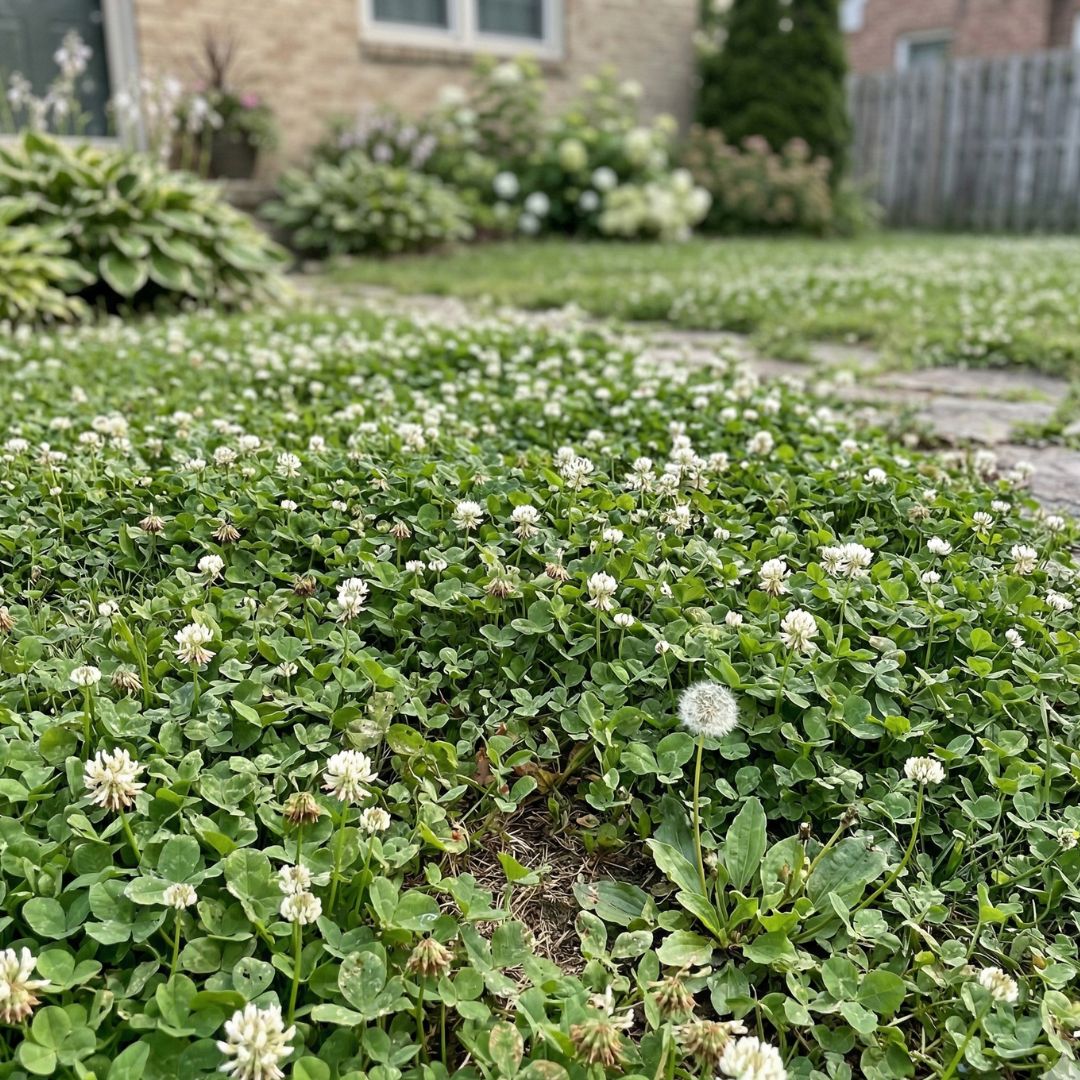
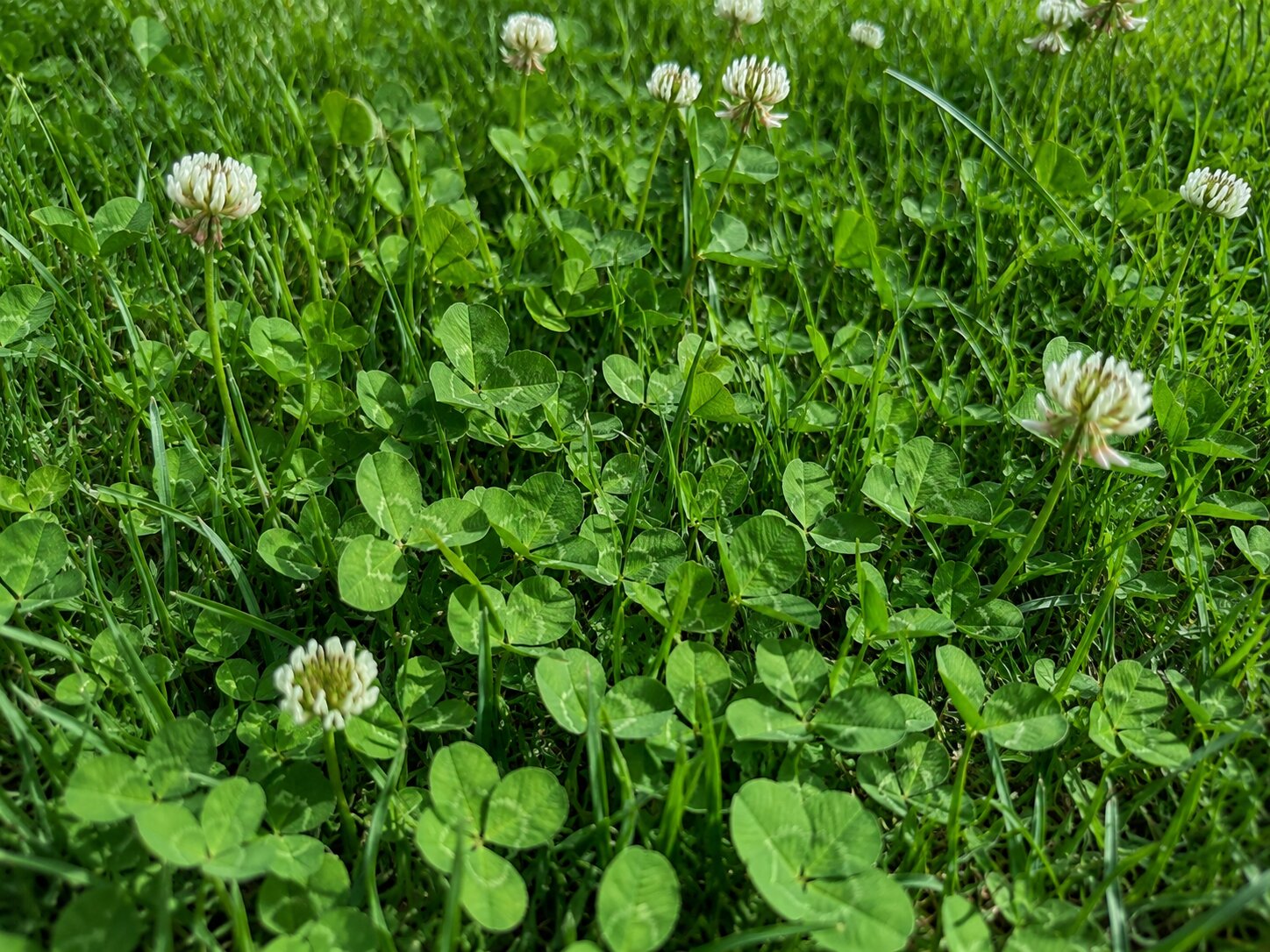
White Dutch clover has 8–15mm leaves and blooms freely from May to September. It reaches 6–8 inches unmowed and sits at 2–4 mown. It looks like clover, because it is clover.
| HearthClover white Dutch | FineFolio micro clover | |
|---|---|---|
| Leaf size | 8–15mm | 2–4mm |
| Unmowed height | 6–8 inches | 2–4 inches |
| Bloom frequency | High, May–Sep | Minimal at mow height |
| Pollinator value | Excellent — 80+ bee species | Good |
| HOA compatibility | Not ideal — visible bloom | Compatible |
| Nitrogen fixation | Equal — same species | Equal — same species |
| Best for | Maximum ecology, pollinators, pets | Fine texture, appearance-conscious lawns |
The nitrogen is identical. They are the same plant with the same root bacteria. The entire difference is how much you see.
And three hours of sun
Minimum, for both the clover and the fine fescue base. Below that the clover thins and whatever grass is present takes over. → Shade lawn seed
Before you sow
Why white clover lawns disappoint
Four causes. Three you can fix before you sow.
Sown alone on bare soil
Clover does not form a dense enough surface by itself. On bare ground it establishes in patches with visible soil between them, and that soil fills with whatever blows in before the clover closes it. Clover spreads by stolons and does close eventually — it is the first season that catches people out, and the first season is when the weed seed bank is most active.
Fix: a fine fescue base with clover through it. This is the single most useful thing on the page.
It looks like clover
Not a defect. But people who have seen photographs of an immaculate fine-textured clover lawn are usually looking at micro clover, which has leaves a quarter of the size and barely blooms.
Fix: decide which you actually want before ordering. The comparison table is above.
Still fertilising
Nitrogen grows grass, grass outcompetes clover, and a fed clover lawn reverts within two seasons.
Fix: stop. The clover is the fertiliser — it fixes the equivalent of roughly 100 lb of nitrogen per acre per year through Rhizobium root nodules. And never use weed-and-feed. Broadleaf herbicide kills clover; that is precisely what it is formulated to do.
The one we cannot fix: clover is a component, not a lawn
Sold as a bag on its own it will always look patchier than the photograph, because a lawn needs something occupying the space between the clover plants.
Our own order history says this plainly: HearthClover has never once been bought alone. Every order containing it contains something else — usually a fescue. We sell it as a component because that is what it is. A page that pretended otherwise would be selling you a disappointment for $7.
Choose your white clover lawn
The white clover lawn — fescue and clover together
GroundKeep · fine fescue blend + inoculated white Dutch clover · 3+ hours · Zones 3–9 · from $28 per 1,000 sq ft. This is what a white clover lawn actually is, and it is the base of every kit here.
| Component | Species | Role |
|---|---|---|
| Fine fescue blend | Creeping red, chewings, sheep | Structural backbone. Fine-bladed, shade tolerant, naturally low at 3–5 inches, drought tolerant once established |
| White Dutch clover (inoculated) | T. repens | Nitrogen fixation. Stolon self-repair of bare patches. Pollinator forage for 80+ bee species. White globe bloom May–Sep |
The two share almost exactly the same maintenance profile — 0–2 mows a year, no fertiliser, part shade down to three hours, established in one season. That is why they work as a mix rather than as two plants competing.
The ratio is deliberate, and the reason is worth knowing. White Dutch clover seed is far smaller and lighter than fine fescue — roughly 800,000 seeds per pound against 450,000. So a small amount of clover by weight delivers a substantial clover presence by plant count.
Too little clover and there is not enough density to sustain the nitrogen cycle. Too much and the clover dominates the fescue in the establishment year, tipping the lawn away from the low-growing grass-textured surface the mix is designed to produce. The blend is calibrated for the fescue to stay dominant.
Water use: UMN Extension documents fine fescue lawns as requiring 50–75% less water than Kentucky Bluegrass after establishment, and GroundKeep “survives 3–4 weeks without rain by going dormant then recovering.”
| Bag | Price | New lawn | Overseeding |
|---|---|---|---|
| Tiny Bag | $6.99 | 60 sq ft | 120 sq ft |
| Small Bag | $6.99 | 120 sq ft | 240 sq ft |
| Medium Bag | $9.43 | 250 sq ft | 500 sq ft |
| Large Bag | $22.29 | 750 sq ft | 1,500 sq ft |
| XL Bag | $35.15 | 1,250 sq ft | 2,500 sq ft |
Choose your white clover lawn
Pure white Dutch clover
HearthClover · 100% Trifolium repens · 3+ hours · Zones 3–9 · 6–8 in unmowed · $6.99 / 500 sq ft → $43.24 / 10,000 sq ft · from $4.32 per 1,000 sq ft.
“Full clover lawn from bare soil: germinates 5–10 days. Full coverage in one season. Mow 2–4 times per year. No fertiliser needed once established.”
“Overseeding into existing grass: broadcast directly into grass. No turf removal needed. Adds nitrogen to the existing lawn within the first season.”
The coverage is why it is cheap. A Tiny bag covers 500 sq ft and a Small covers 1,000 — white clover is sown far more thinly than grass, because each plant spreads. A 2,000 sq ft lawn takes an $11.05 bag.
That is the correct price for what it is. It is not a lawn on its own, and we would rather you bought it as a component than as a disappointment.
Pollinator value is the highest of anything we sell. The Xerces Society documents white Dutch clover as forage for over 80 bee species, blooming May through September — the longest forage window in the catalogue. HearthClover is the full-flower form of the species, the version bred for bloom rather than against it.
Rated Excellent for five separate uses: full clover lawn from bare soil, overseeding, pollinator forage, reducing fertiliser cost, and pet-friendly lawns.

Choose your white clover lawn
Other clovers worth knowing
CloverCore — two-clover mix, white Dutch plus strawberry clover. “Strawberry clover’s deep root system maintains density through summer drought” and tolerates saline and alkaline soil.
TriLeaf — three clovers including red and crimson, which grow taller and bloom more visibly. Same price band as HearthClover.
StrawberryField — the only clover in our range rated High for foot traffic.
FineFolio — micro clover, if you want the nitrogen without the visibility. → Clover lawn seed
Over 1,000 sq ft, the fescue base is the cost and the clover is close to free — the kits below are built that way.
The kits
One order, the whole lawn
Each is the fescue-and-clover base, an extra bag of pure white clover to lift the clover content, a flowering accent and a small bag of repair mix. Untick anything you don’t want.
Two things stated honestly. The per-1,000 sq ft figure is not shown on this page. At kit scale it works out under $20, and that number tells you more about how thinly clover sows than about value — comparing it to the $74 on the thyme page would be misleading in both directions.
And there is no middle tier. One GroundKeep XL covers 1,250 sq ft; anything bigger doubles the base bag, and the calculator above sizes it exactly rather than rounding a kit at you.
How to plant
How to plant white clover
Germinates in 5–10 days at soil temperatures of 50–65°F — the fastest thing in our range, and one of the easiest to establish.
For a new lawn on bare soil
- Prepare. Rake smooth and firm. Remove existing vegetation.
- Broadcast at the surface. Do not bury — the seed is tiny and needs light contact with the soil surface. Burying it is the one unrecoverable mistake.
- Rake lightly. A single light pass with a leaf rake. Do not cover deeply.
- Water lightly and consistently. Two light waterings a day for the first 7–14 days. Do not let the surface dry between waterings — a single hot dry day at day four can cost the sowing.
- Hold mowing for 4–6 weeks while the seedlings root.
For overseeding an existing lawn
- Mow to 1.5–2 inches and rake out the thatch so seed reaches the soil surface. This is the step that decides whether overseeding works.
- Broadcast at roughly half the new-lawn rate.
- Rake lightly, then water as above.
- Hold mowing for 4–6 weeks.
Clover integrates fully within one season. You will see it through the grass by late summer.
Ongoing
Mow at 2–4 inches. That height keeps the stand dense and the bloom manageable — high enough that the clover flowers, low enough that it does not flop. Two to four cuts a year is typical.
Never fertilise, and never use weed-and-feed.
Overseed worn patches each spring if the lawn takes traffic. Clover self-repairs by stolon, but giving it a head start costs almost nothing.
When to sow
Forgiving on timing
White clover is more forgiving than fine fescue, because it germinates in roughly half the time and roots quickly. If you have missed the ideal window by a few weeks, it is still worth sowing.
| Zone | Window | Notes |
|---|---|---|
| 3–5 | Apr–May at 50°F soil | Spring or autumn both work |
| 5b–7 | Spring or autumn | Best bloom and spread. Longest season |
| 8–9 | Oct–Nov | Autumn only, for best establishment |
What to expect
The fastest establishment of anything on this site
And the only page here with no discouraging stage.
There is no unconvincing stage on this page. If clover has not germinated within ten days, something is wrong — most likely the seed was buried, or the surface dried out between waterings.
On the first bloom: it arrives in the first season and it is more visible than it will be later, because young plants sit proportionally higher against thin grass. As the fescue thickens, the clover settles into it.
Questions
What people ask before buying
When should I plant white clover?
April–May when soil reaches 50°F, or August–September. In Zones 8–9, October–November. It is forgiving on timing because it germinates in 5–10 days.
How tall does white clover grow?
6–8 inches unmowed, 2–4 inches mown. This is the HOA question in disguise — if there is a height covenant, check it against that figure, and consider micro clover instead, which stays at 2–4 inches unmowed.
When does white clover bloom?
May through September, and freely. That is either the appeal or the problem depending on who you are and what your covenant says. It is the longest pollinator forage window of anything we sell.
Does white clover grow in shade?
Three hours of direct sun minimum, the same as micro clover. Below that, fine fescue on its own.
Is white clover safe for dogs?
Yes. ASPCA Animal Poison Control lists Trifolium repens as non-toxic to dogs, cats and horses. It is also soft underfoot and self-repairing, which matters practically — a clover lawn closes worn patches without reseeding.
How do I plant white clover seed?
The planting section above has both methods. Surface sow, do not bury, water twice daily for a week, hold mowing for four to six weeks.
How do I grow white clover from seed?
The same. It is genuinely one of the easiest things to establish — 5–10 days to germinate and full coverage in one season.
What is the difference between white clover and micro clover?
Same species, different cultivar. White Dutch has 8–15mm leaves, grows to 6–8 inches unmowed and blooms freely. Micro clover has 2–4mm leaves, stays at 2–4 inches and barely blooms.
Nitrogen fixation is identical — same plant, same root bacteria. Choose entirely by how visible you want it.
Will white clover take over my lawn?
In a mix with fescue, no — the two reach a stable balance, and our blend is calibrated by seed count to keep the fescue dominant. Clover takes over only where the grass is already weak, which usually means shade, compaction or drought.
If clover is dominating, it is telling you something about the grass rather than about the clover.
Why was clover removed from lawn seed mixes?
It was standard until the 1950s, valued by agronomists for nitrogen fixation, drought tolerance and soft texture. It was reclassified as a weed when broadleaf herbicides came to market and everything broadleaf had to be defined as a problem to justify the product.
Penn State, UMN and UMD Extension all document white clover as an appropriate low-maintenance lawn component. The agronomy never changed.
Does white clover fix nitrogen without inoculation?
Not reliably. Nitrogen fixation depends on Rhizobium leguminosarum forming nodules on the roots, and those bacteria have to be present. In soil that has not grown clover before, uninoculated seed may take years to nodulate or never do it.
Our clover is coated with live Rhizobium before packaging, so fixation begins in the first season. It is worth checking on any clover seed you buy.
How much water does a clover and fescue lawn need?
UMN Extension documents fine fescue lawns as needing 50–75% less water than Kentucky Bluegrass once established. Our mix survives three to four weeks without rain by going dormant and then recovering.
Will it attract bees?
Substantially — over 80 species, blooming May to September. If that is the goal, this is the right clover; micro clover blooms far less.
Can I mow a clover lawn?
Yes, at 2–4 inches. Mowing does not harm it and keeps the stand dense. Clover flowers at and below that height, so you keep the bloom.
Why buy from us
Inoculated seed, calibrated ratios, real sources
Non-GMO, USA-grown seed. Inoculated clover — live Rhizobium leguminosarum applied before packaging, so nitrogen fixation begins in the first season rather than whenever the right bacteria happen to arrive. Blend ratios calibrated by seed count rather than by weight, so the clover density is right in the established lawn rather than right in the bag.