
Creeping Thyme Seeds
A fragrant, flowering lawn that stays at 2–4 inches and never needs mowing. Two questions decide whether it will work in your yard: how much sun the spot gets, and how fast water drains out of it.

Sizing
Tell us your square footage
Plan the whole yard in one order — add a row per space and give each its own product: ThymeWalk across the sunny lawn, ThymeTurf on the crossing, ElfWalk in the paver gaps. Every bag is sized from its product page’s coverage table.
Not sure how many hours of sun you get? The next section shows you how to measure it in thirty seconds.
The two questions
How much sun, and how fast does it drain?
Creeping thyme fails two ways. Both are predictable before you sow, and both take five minutes to check.
Measuring your sun
Pick a clear day — this does not work under overcast. Look at the spot at 9am, 11am, 1pm, 3pm and 5pm. Five checks, thirty seconds each.
Count the ones where direct sunlight lands on the ground. Not general brightness, not dappled light filtering through leaves — direct, unbroken sun on the soil. Multiply your count by two, and that is your hours.

Do it in the season you intend to sow, and be aware the answer changes through the year. A spot that gets seven hours in June may get three in September as the sun drops and shadows lengthen. If you are close to the threshold, check twice.
Creeping thyme needs six hours. NC State Extension documents Thymus serpyllum as one of the most reliable low-maintenance ground covers for full-sun, drought-prone sites — and the emphasis is on full sun. Our own product notes are blunt about the alternative: “Requires full sun (6+ hours daily). Shade causes thin, leggy growth.”
Measuring your drainage
This is the test almost nobody does, and it decides as much as the sun does.
Dig a hole about a foot across and a foot deep. Fill it with water and let it drain completely — this saturates the surrounding soil so the second measurement is meaningful. Fill it again, and time how long the second fill takes to disappear.
| Second drain | What it means | What to do |
|---|---|---|
| Under 4 hours | Sharp drainage | Sow as is. This is thyme’s ideal |
| 4–12 hours | Workable | Amend with coarse grit or sharp sand before sowing |
| Over 12 hours | Thyme will rot | Choose fine fescue instead |
Thyme is a Mediterranean plant. It evolved on thin, stony, sun-baked ground and it tolerates drought, heat and poor soil far better than most lawn species. What it does not tolerate is wet feet — thyme rots where grass merely sulks.
This is the opposite of what most lawn seed wants, and it is precisely why thyme succeeds in the places grass fails. A rocky south-facing bank that will not hold a lawn is thyme’s best site.
What each combination means
| Sun + drainage | What works | What will fail |
|---|---|---|
| 6h+, sharp, ornamental | Red creeping thyme lawn | — |
| 6h+, sharp, occasional crossing | Thyme with a fine fescue blend | Pure thyme under repeated wear |
| 6h+, sharp, daily traffic | Thyme + fescue only | Any pure thyme lawn |
| 6h+, slow drainage | Amend first, or fine fescue | Thyme in wet ground |
| 4–6h, any drainage | Clover or fine fescue | Every thyme we sell |
| Under 4h | Nothing on this page | All of it |
Before you sow
Why creeping thyme lawns fail
Four causes. Three you can fix before you sow.
Not enough sun
The commonest failure by a wide margin, and the one people misdiagnose most often, because thyme in four hours of sun does germinate. It comes up, looks fine for a season, and then gradually opens out and stops flowering. By the time it is obviously failing, two years have passed and the seed is long forgotten.
Fix: measure before you sow. Six hours, or a different plant. There is no cultivar of creeping thyme that tolerates shade — the whole genus wants sun.
Wet or heavy ground
Thyme rots. Not thins, not struggles — rots, from the crown, usually over winter when the ground holds water and the plant is not growing enough to use it. Our own notes on the variety collection say it plainly: “Thymes need full sun and sharp drainage.” Heavy clay that stays wet through February will kill an established thyme lawn in a single wet spring, three years after it looked permanent.
Fix: the drainage test above. If the second fill takes more than four hours, work coarse grit or sharp sand into the top four inches before sowing. On heavy clay, raise the bed slightly rather than digging into it — you cannot drain a hole in clay by digging deeper.
Walked on before it knits
Thyme takes a full season to form a continuous mat. Traffic during the first year opens gaps, and weeds occupy those gaps faster than the thyme closes them.
Fix: keep off it for the first season. If the route is essential, lay temporary stepping boards. Or blend with fine fescue from the start — the fescue carries the wear while the thyme establishes, and our fescue-and-thyme mix “tolerates foot traffic better than most flowering ground covers” for exactly this reason.
The one we cannot fix: good soil is the wrong soil
If your ground is rich, moisture-retentive and regularly irrigated, thyme will disappoint you no matter what else you get right. Our planting guide is explicit: “Do not add compost or fertiliser — thyme prefers lean soil.” That is not a labour-saving shortcut. Fertility produces soft, sappy, open growth that flops rather than mats, flowers poorly, and rots more readily in winter.
A well-tended vegetable-garden soil is actively hostile to a thyme lawn. So is a lawn that has been fed and irrigated for years. If you have good soil and good irrigation, you already have the conditions for a good grass lawn — and thyme is for the parts of the garden where that is not true. The sunny bank, the gravel border, the strip beside the drive that bakes all afternoon.
Choose your thyme
Red creeping thyme — the base
ThymeWalk · Thymus serpyllum · 6+ hours · Zones 3–9 · 2–4 inches · from $74 per 1,000 sq ft at Large and XL.
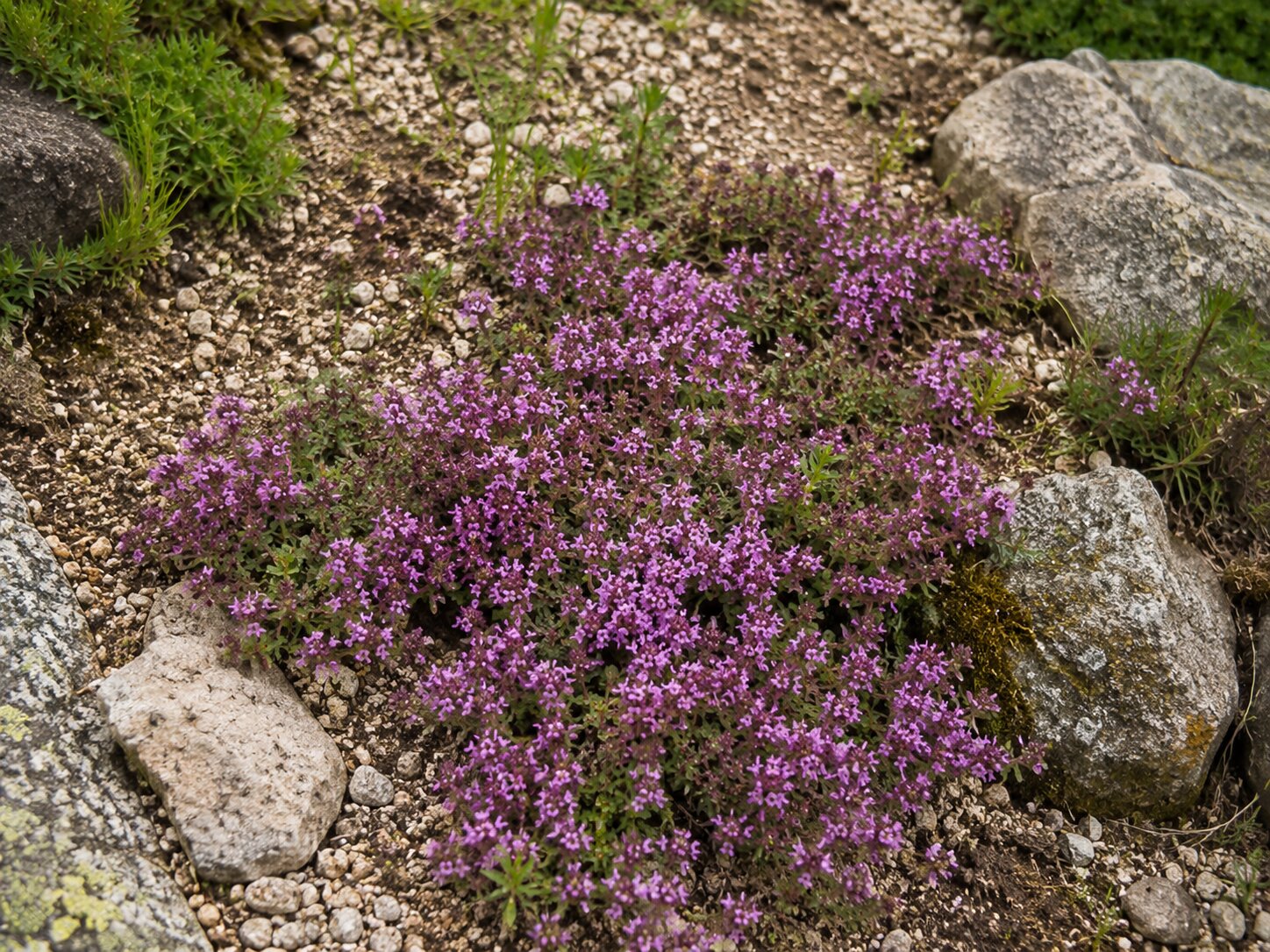
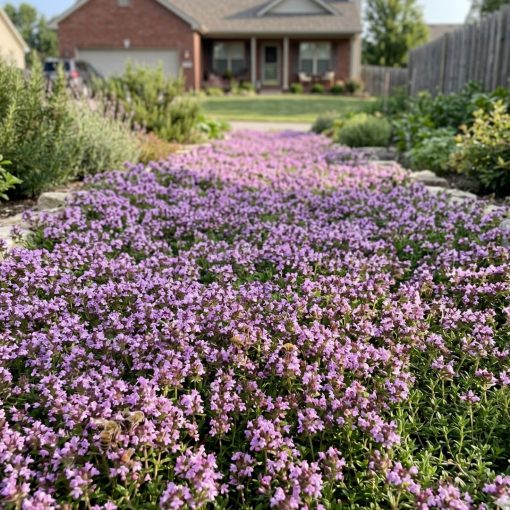
The densest mat-forming thyme in the range, blooming purple-pink from May to July. This is the base of every kit on this page.
“Densest mat-forming habit; spreads by woody stems; strong herbal fragrance when crushed; drought and heat tolerant; firewise; widest cold hardiness range.”
| Bag | Price | New lawn | Overseeding | Per 1,000 sq ft |
|---|---|---|---|---|
| Tiny Bag | $6.99 | 62 sq ft | 125 sq ft | $113 |
| Small Bag | $11.99 | 125 sq ft | 250 sq ft | $96 |
| Medium Bag | $22.99 | 250 sq ft | 500 sq ft | $92 |
| Large Bag | $36.99 | 500 sq ft | 1,000 sq ft | $74 |
| XL Bag | $91.99 | 1,250 sq ft | 2,500 sq ft | $74 |
Where it excels — from its own use ratings
| Use | Rating | Why |
|---|---|---|
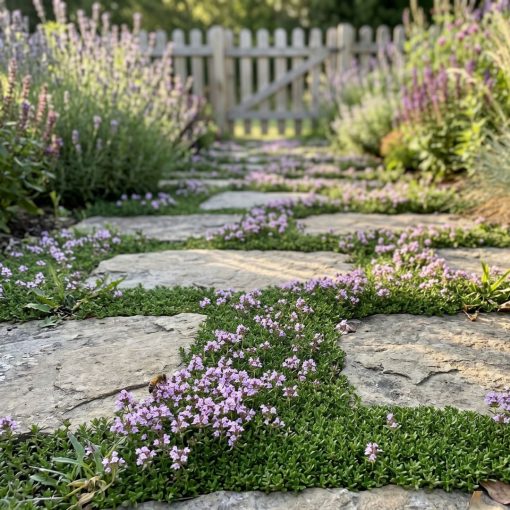
| Between stepping stones and pavers | Excellent | “Handles gap conditions perfectly. Releases fragrance with each step” |
| Sunny slope, erosion control | Excellent | “Dense mat suppresses weeds and anchors soil. Fastest cover on dry exposed banks” |
| Rock garden, dry border | Excellent | “Thrives in the sharp drainage and heat of rock garden conditions” |
| Fire Zone 1 defensible space | Excellent | “UC ANR firewise confirmed” |
| Full lawn replacement, low traffic | Very Good | “Ornamental front lawns with light foot traffic. Not for play areas” |
| Shaded sites | Poor | “Shade causes thin, leggy growth” |
On the firewise rating: both UC ANR and CSU Extension list creeping thyme as a firewise ground cover. For anyone in a fire-prone zone, that matters — a low, green, high-moisture mat reduces fuel load in the defensible space immediately around a building, where ornamental grasses and shrubs increase it. Keep it green with occasional deep irrigation through fire season.
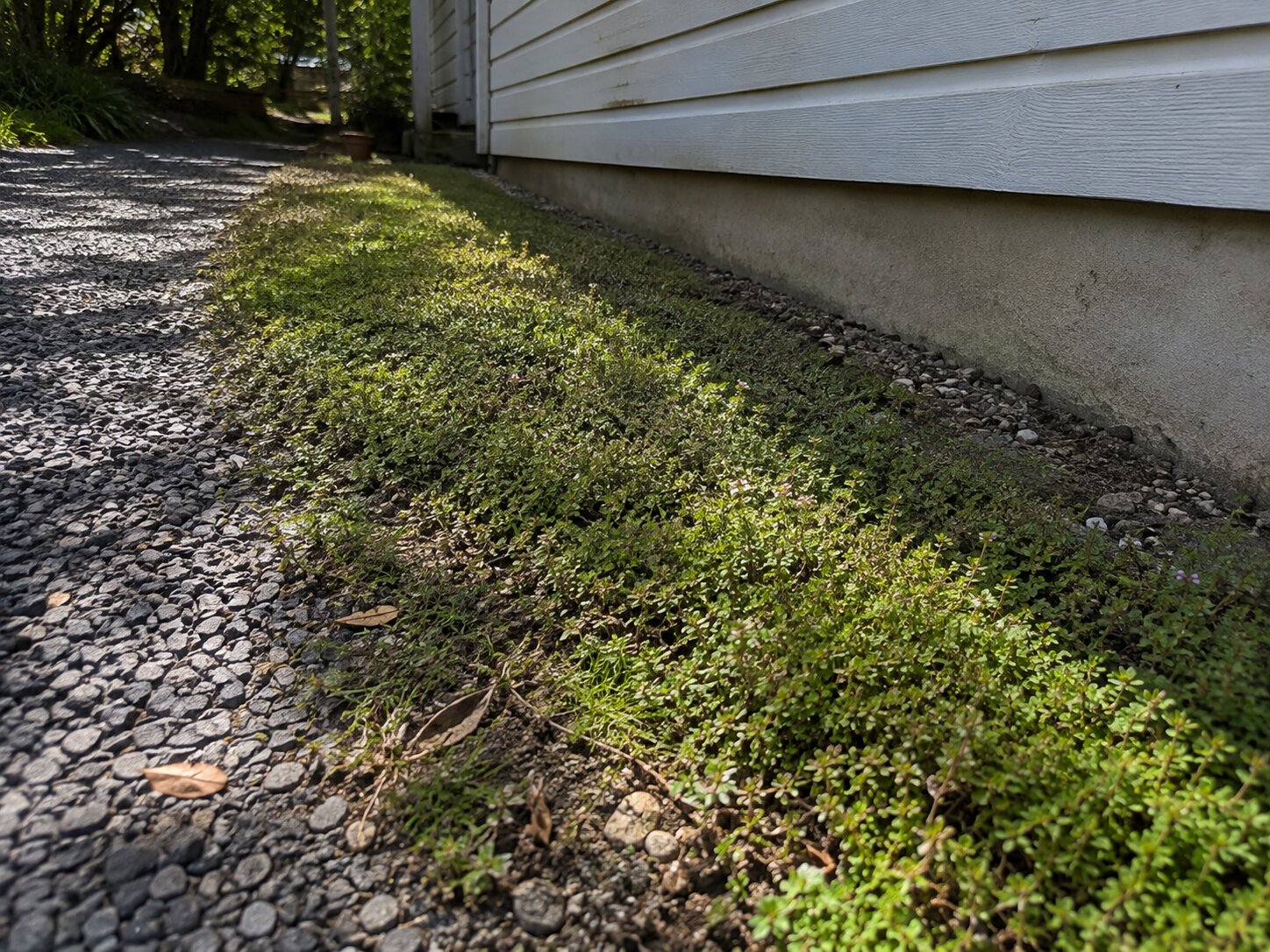
On the fragrance, which is genuinely the reason many people choose it: walking on thyme crushes the foliage and releases its essential oils. A thyme path is one of the few surfaces in a garden that rewards being walked on. It is not a marketing claim — it is why the plant has been grown beside doorways for centuries.
Choose your thyme
Companion varieties
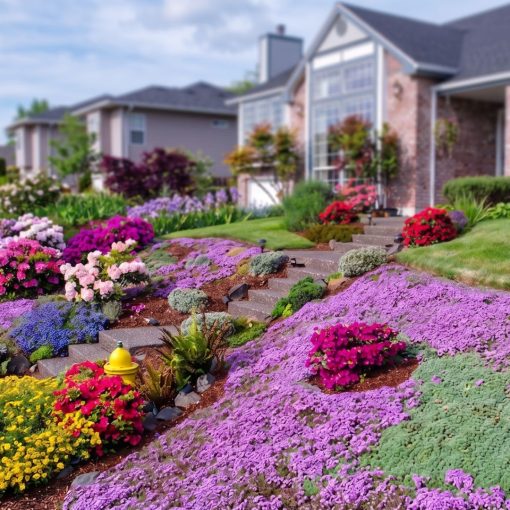
Mixing varieties gives a tapestry effect — patches of different colour and texture reading as one surface — and staggers the bloom across a longer window. All need the same six hours and the same sharp drainage.

| Variety | Species | Height | What it adds |
|---|---|---|---|
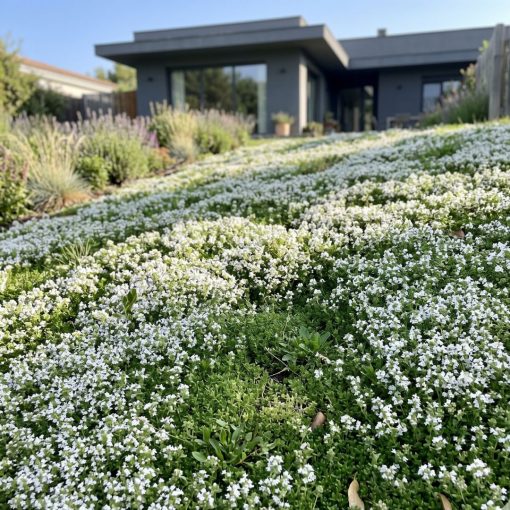
| WhiteWalk | T. serpyllum ‘Album’ | 2–4 in | White bloom against the red. The strongest visual contrast |
| ElfWalk | T. serpyllum ‘Elfin’ | 1 in | The lowest and densest mat available. Slowest to establish |
| SilkWalk | T. serpyllum | 2–4 in | The wild species type. Strongest fragrance |
| ThymePalette | four cultivars | mixed | “Four varieties give colour and texture” in one bag |
Tougher underfoot
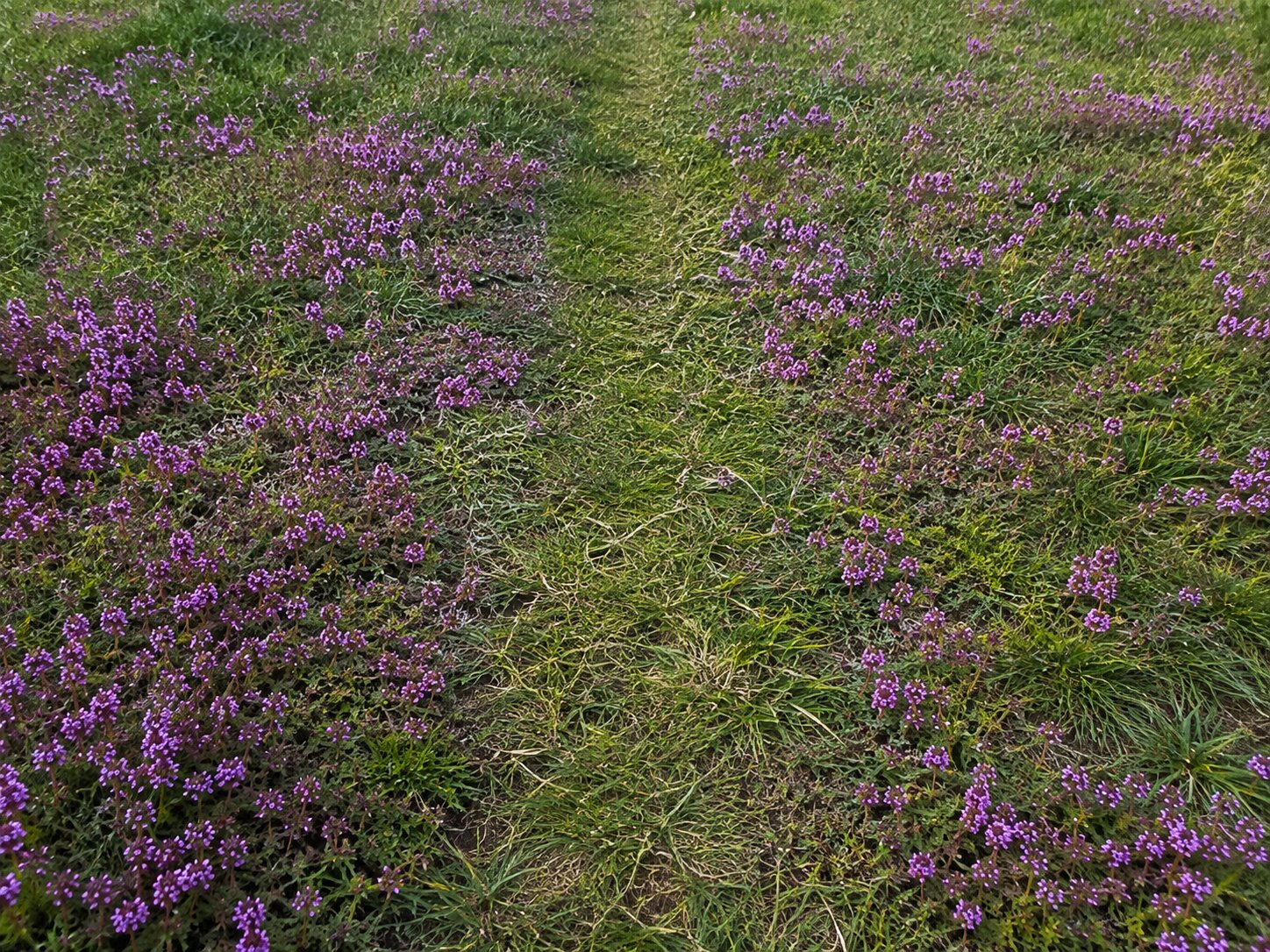
ThymeTurf · thyme + fine fescue · 4+ hours · $15.99 / 270 sq ft → $67.99 / 1,325 sq ft. From $51 per 1,000 sq ft — a third cheaper than pure thyme, because fescue makes up the bulk and fescue seed costs less.
“Fine fescue tops out at 3–5 inches unmowed. Releases a pleasant herbal fragrance when walked on, and tolerates foot traffic better than most flowering ground covers.”
The fescue carries the wear and provides the structure; the thyme provides the flowers and the scent. Choose this over pure thyme if the lawn gets crossed regularly, or if your sun is between four and six hours rather than a clear six. Note it comes in two sizes only, covering to 1,325 sq ft.
Not on this page: wooly, carpet, mother-of-thyme and Breckland thyme are accent plants rather than lawn bases — better between pavers or as small-scale features than across an open area. → Path and stepping-stone planting
The kits
One order, the whole planting
Each kit is a base thyme, a companion variety for contrast, two flowering accents and a small bag of repair mix. Untick anything you don’t want — the total updates.

Why a kit rather than a bag. A single-variety thyme lawn is uniform, which is exactly what some people want. A mixed planting reads as more established and flowers across a longer window, because the varieties bloom at slightly different times and hold their colour differently through the season.
The accents — self-heal, English daisy — sit at ground level between the thyme and flower when the thyme is not. They are sown thinly across the whole area rather than in proportion to it, which is why every kit contains one bag regardless of size.
The repair mix is not an upsell. Bare spots appear in the first year on any new planting, usually where water pooled or a bird bathed. Fixing them within the first season stops weeds establishing in ground the thyme has not yet reached.
Larger areas cost less per square foot — the Whole Lawn kit runs about 40% below the Starter per 1,000 sq ft. Most of that saving happens between the Tiny and Large bags rather than at the top of the ladder.
How to plant
How to plant creeping thyme
Thyme seed is tiny and needs light to germinate. The single most common mistake is burying it, and it is unrecoverable — buried seed simply never comes up, and by the time you know, the season has gone.
- Prepare the seedbed. Remove all existing vegetation — thyme cannot compete with established grass or weeds, and this is the step that decides most outcomes. Rake smooth and firm. Do not add compost or fertiliser. Thyme prefers lean soil. If you are working with heavy ground, add coarse grit or sharp sand for drainage rather than organic matter for fertility.
- Broadcast at the surface. Scatter the seed evenly. Do not rake it in or cover it. Over larger areas, walk the ground twice at right angles — once in each direction — rather than once. Thyme seed is fine enough that a single pass leaves visible stripes when it germinates.
- Press for soil contact. Firm gently with a lawn roller, or by walking across the whole seeded area. Seed needs contact with soil, not burial in it. This is the difference between germination and seed sitting on top of dry crumbs.
- Water lightly and consistently. Keep the surface moist with light daily watering for 14–21 days. Soil temperature must be 60–70°F for reliable germination, which is why timing matters more than technique — see the next section.
First year care
Weed by hand through the first season. This is the real work, and it is the difference between a thyme lawn and a weed patch with thyme in it. Once the mat closes it suppresses most annual weeds itself, but it cannot do that until it has closed.
Do not feed it. Ever, really — but especially not in year one.
Water only in genuine drought. Established thyme is highly drought tolerant. Watering a thyme lawn out of habit is one of the more reliable ways to lose it.
When to sow
Soil temperature, not calendar date
Thyme needs 60°F to germinate reliably, and sowing into cold ground wastes the seed rather than delaying it.
| Zone | Window | Notes |
|---|---|---|
| 3–4 | Apr–May, when soil reaches 60°F | Cold-hardy to Zone 3. Dies back in the hardest winters with reliable spring recovery. The autumn window is too short here |
| 4–6 | Apr–May or September | Dense mat year-round; the most reliable performance band. Semi-evergreen through milder Zone 5–6 winters |
| 6b–8 | Spring or autumn | Longest bloom period, evergreen through winter, best overall performance |
| 8b–9 | Spring, with sharp drainage | Excellent in summer heat given drainage. Water occasionally in peak heat. Bloom window shifts earlier, to Mar–Apr |
Autumn sowing works in Zones 4 through 8 and gives roots a head start before the following summer. In Zones 3 and 4 the season is too short — the seedlings will not be established enough to survive the first winter, so sow in spring.
What to expect
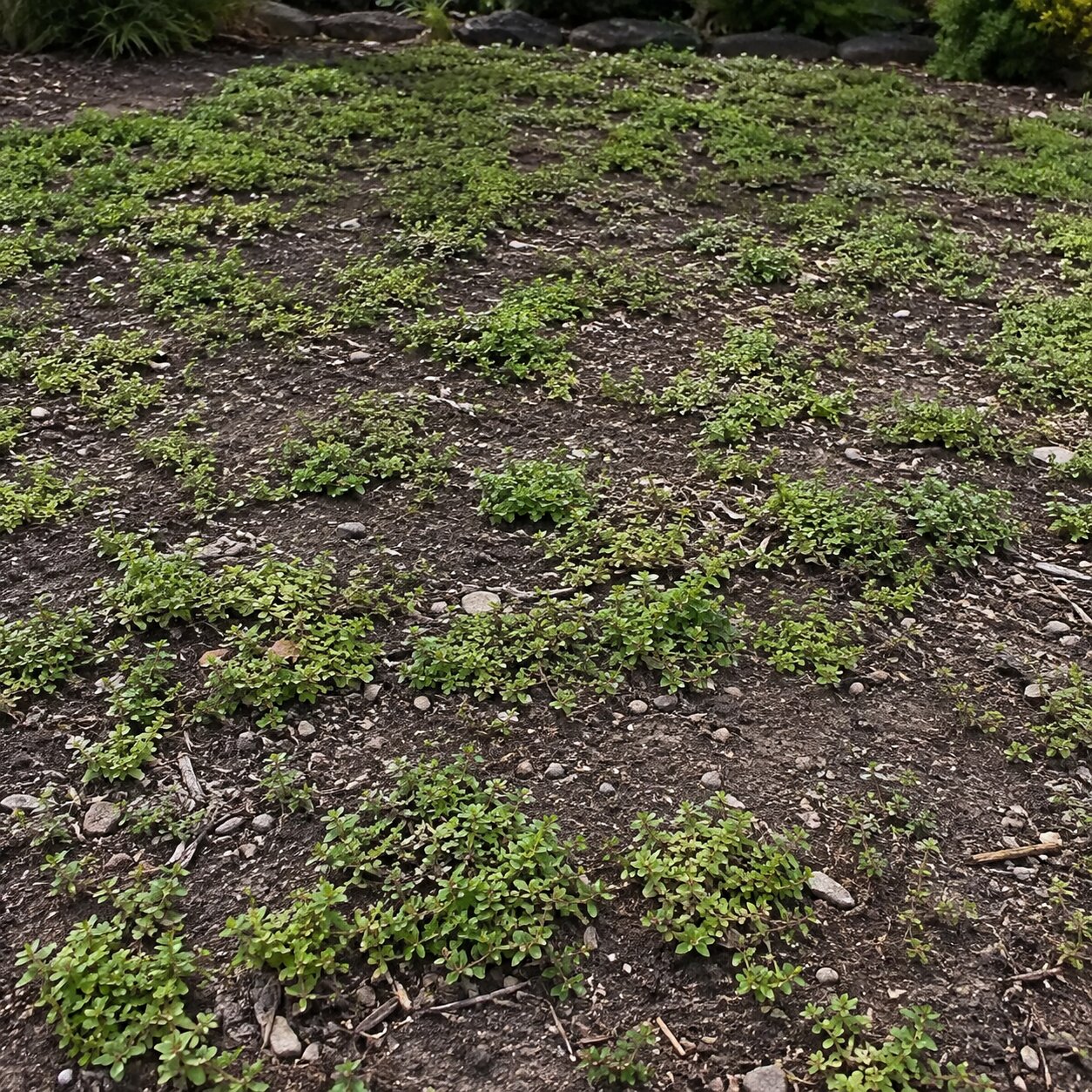
Every new planting has a stage that looks like failure
For thyme it arrives around day ten, and it is the point at which most people conclude the seed was bad.

Season two is the honest answer
A thyme lawn is not a fast lawn. Grass gives you a green surface in six weeks; thyme gives you a mat in eighteen months. What you get in exchange is a surface you never mow, never feed and rarely water, that flowers for two months a year and smells like the Mediterranean when you walk across it. It is evergreen in Zone 6b and warmer, semi-evergreen in 5 and 6, and it comes back reliably in Zone 3 even after dying back hard.
If you need coverage this summer, buy plants rather than seed. Plugs at 8–12 inch spacing give you a mat in one season. The questions below have the arithmetic.
What the first winter looks like
In Zones 3 through 5, expect the foliage to brown and die back. This is normal and not a failure — recovery from the woody stems in spring is reliable. In Zone 6b and warmer, it stays green through winter.
Questions
What people ask before buying
Where can I buy creeping thyme plants near me?
Garden centres stock plugs in spring, and for a small area — a few paver gaps, a border strip, a patch beside a doorway — plants are the faster route and often the sensible one.
For anything over about 100 sq ft the arithmetic changes sharply. Plugs at 8–12 inch spacing run roughly $2–4 each, so 100 sq ft needs 100–150 plants — somewhere between $200 and $600. Seed covers that same 100 sq ft for under $10, and the full 1,250 sq ft for $91.99.
Plants buy you a season. Seed buys you the area. For a lawn-sized planting, seed is the only proportionate option; for a gap between two flagstones, buy a plug.
How do I plant creeping thyme?
Surface sow, never bury, firm for contact, and keep the surface damp for two to three weeks. The planting section above has the four steps in full. The two things people get wrong are covering the seed and adding compost.
When should I plant creeping thyme?
When soil reaches 60°F — April to May in most zones, or September in Zones 4 through 8. The zone table above has the windows. Soil temperature matters more than the date on the calendar.
How do I grow creeping thyme from seed?
The same as planting it. The one additional thing worth knowing is patience: germination in 7–14 days, meeting up around month six, full mat in season two.
Does creeping thyme grow in shade?
No. It needs six or more hours of direct sun. In shade it grows thin and leggy, flowers poorly and thins out by the second summer. There is no shade-tolerant creeping thyme — the genus wants sun.
For a shaded site you want fine fescue, which works down to two hours.
How long does creeping thyme take to establish?
Germination in 7–14 days. Plants meet around month six. Full mat and full bloom in season two. ElfWalk is slower at every stage — 14–28 days to germinate and three seasons to a dense mat.
Is creeping thyme safe for dogs and cats?
Yes. ASPCA Animal Poison Control lists Thymus species as non-toxic to dogs, cats and horses. It is also soft underfoot and low enough that dogs do not flatten it the way they flatten taller planting — though a route a dog runs daily will thin it, like any living surface.
Can you walk on a creeping thyme lawn?
Light foot traffic, yes — and it releases fragrance when you do, which is one of the reasons people plant it.
Daily traffic across the same route will thin it. Thyme is rated Very Good for “ornamental front lawns with light foot traffic” and explicitly “not for play areas or daily-use pathways.” For a path or a lawn that gets real use, blend it with fine fescue, or use elfin thyme in the worn line specifically.
Will creeping thyme choke out weeds?
Once established, the mat suppresses most annual weeds — it is dense, low and leaves little bare soil for seed to land on.
In year one it will not. Hand weeding through the first season is the single biggest factor in whether you end up with a thyme lawn or a weed patch with thyme in it.
Does creeping thyme come back every year?
Yes. It is a perennial evergreen in Zone 6b and warmer, semi-evergreen in the milder parts of Zones 5 and 6, and it dies back in the hardest Zone 3–4 winters with reliable spring recovery from the woody stems.
Is creeping thyme good for slopes?
Very. It is rated Excellent for “sunny slope, erosion control” — “dense mat suppresses weeds and anchors soil. Fastest cover on dry exposed banks.”
On any slope over 10%, use a seed tackifier when sowing.
Is creeping thyme firewise?
Yes — both UC ANR and CSU Extension list it as a firewise ground cover suitable for Zone 1 defensible space. A low, green, high-moisture mat reduces fuel load close to a building. Keep it green with occasional deep irrigation during fire season.
Does creeping thyme need mowing?
No. It stays at 2–4 inches on its own. Some people shear it lightly after flowering to tidy the spent blooms, but it is optional and the plant does not require it.
Why buy from us
Honest ratings, stated coverage, real sources
Non-GMO, USA-grown seed. Coverage stated in square feet on every product, so you can size a planting before you order rather than guessing from a weight. A planting guide with every order, and sizing by area rather than by bag — the calculator on this page gives you the whole kit for your square footage in one order rather than leaving you to work out how many bags of what.
And honest ratings, including the ones that lose us a sale. Creeping thyme is rated Poor for shade in our own product data, and that rating is on this page rather than buried.