
Grass Seed for Dogs
Most people asking about dog lawns are really asking whether what goes on the lawn is safe. Start there — then the question of which seed survives a dog becomes straightforward.
Sizing
Size your lawn
Add a row per area — the main lawn, the repair patches, the kids’ corner — and give each its own product. Every bag is sized from its product page’s coverage table.
The defining question
What actually goes on your lawn?
Before choosing seed, look at what you currently apply. For a dog’s exposure this matters more than the grass species does.
The products people ask about
Weed and feed. Combination products pair a broadleaf herbicide with fertiliser. Labels specify a re-entry interval — commonly until the product has dried or been watered in. Read the label on the specific product and follow it; that is the manufacturer’s guidance and it is more reliable than anything we could generalise.
Lawn seed itself is safe. Every species in our dog products is ASPCA-confirmed non-toxic to dogs, cats and horses. The seed-related hazard people sometimes read about is grass awns — barbed seed heads from ornamental and pasture grasses that lodge in paws, ears and noses. Lawn grass mown at 2–4 inches never sets seed heads, so it never produces them.
Artificial turf. No chemicals, which is the appeal. Against it: the surface holds heat substantially more than living grass on a hot day, it does not drain urine the way soil does so it needs rinsing, and it never repairs itself.
Fertiliser generally. A clover lawn does not need it. That removes a whole category of question rather than answering it.
Then measure the dogs
| Situation | What works | What will fail |
|---|---|---|
| One dog under 25 lb | Most eco-lawn mixes | — |
| One dog over 50 lb, or two | Urine-tolerant blend with repair seed on hand | Fine fescue alone |
| Two or more large dogs | Rhizomatous tall fescue — expect to overseed | Every fine-bladed lawn |
| A worn run | Nothing. Gravel or mulch it | Every seed on the market |
| Any dog, under 4 hours sun | Nothing in our range establishes reliably | — |
The sun requirement
DogLawn “requires a minimum of 4 hours direct sun at establishment.” Below that it will not establish, and there is no dog-tolerant shade lawn in our catalogue — shade-tolerant species are fine-bladed and thin under paw traffic.
Under four hours with dogs is a genuine gap in the range. Fine fescue will grow there and will not take the wear. → Shade lawn seed, and expect to accept thinning along the routes they use.
Before you sow
Why dog lawns fail
Urine burn
Concentrated nitrogen and salts kill grass in patches. It is the concentration rather than the acidity — the same nitrogen at lawn-feed dilution would green it up.
Fix: species with salt tolerance and lateral spread. Rhizomatous tall fescue “spreads continuously and its natural salt tolerance reduces the effects of pet urine.” Micro clover buffers it further, and has “natural salt tolerance” of its own. Hosing the spot within a few hours dilutes it, but nobody does that reliably, so the species has to do the work.
Wear faster than recovery
Most lawn grass grows upward from a crown. Damage it and it waits to produce a new tiller. A dog wears it faster than that cycle can replace it.
Fix: rhizomatous species that spread laterally underground and refill from the side rather than from above. That is the entire reason RTF exists and the mechanism behind everything else on this page.
Not enough sun at establishment
Four hours minimum. Sown into shade it germinates thin and never thickens enough to take traffic, so the first hard use opens it up.
Fix: sow the sunniest area first, and accept that shaded sections will always be the weakest part of the lawn.
The one we cannot fix: a run will never hold turf
The route a dog takes along a fence line, every day, at speed, always on the same line — compacts soil past the point where roots can penetrate it. It is not a wear problem that better seed solves. It is a soil structure problem, and grass needs air in the soil to root.
Gravel it, mulch it, or accept bare ground and plant either side of it. Every product sold as a solution to a dog run fails, and we would rather say so than take the order.
Choose your dog lawn
The base — a whole dog lawn
DogLawn · RTF + 4N ryegrass + MicroClover · 4+ hours · Zones 3–9 · $10.99 / 140 sq ft → $428.99 / 7,000 sq ft. Everything on this page is ASPCA-confirmed non-toxic — the strict Yes rating, not the weaker “not listed toxic”.
“The primary use case: multi-dog households and heavy daily use. RTF rhizome spread continuously fills worn patches. MicroClover buffers urine burn. 4N ryegrass provides immediate wear tolerance from week one. Best choice for two or more large dogs.”
Three species, three distinct jobs:
| Species | Role |
|---|---|
| RTF tall fescue (3 varieties) | Structural backbone and self-repair. Underground rhizomes spread laterally to fill bare patches. Deep root system for drought tolerance and urine resistance. High salt tolerance. Mow at 2–4 inches |
| 4N perennial ryegrass (tetraploid) | Rapid establishment — germinates 5–7 days. Immediate wear tolerance. Vigorous tetraploid with broad leaves and strong tillering. Bridges the gap while RTF rhizomes establish |
| MicroClover (var. Pipolina) | Nitrogen fixation and urine buffering. Natural salt tolerance reduces urine burn. 2–4mm leaves invisible at 2–3 inch mow height. Stolon spread fills gaps |
Why three rather than one. RTF is the long-term lawn but takes 7–14 days to germinate and months to build a rhizome network. Ryegrass is up in five days and takes traffic immediately, holding the ground while the fescue establishes. Clover feeds both and buffers the urine. Take any one out and the mix stops working: no ryegrass and the lawn is unusable for two months; no RTF and it never self-repairs; no clover and you are back to fertilising.
Also rated Excellent for: dog parks and commercial facilities — “used by Parks & Rec departments specifically. RTF self-repair reduces overseeding frequency.” If it holds a public dog park, it will hold your garden. HOA front yard with a dog — “MicroClover is invisible at 2–3 inch mow height. Maintains a conventional lawn appearance while delivering all eco-lawn benefits.” Overseeding into existing tall fescue — “designed for overseeding into existing tall fescue sod. The RTF rhizomes knit with the existing stand for a seamless result.” If you already have a tall fescue lawn, this is the cheap route.
Choose your dog lawn
High-traffic alternatives
CloverSport · 3+ hours — “built for daily foot traffic. Handles dogs, children, regular foot traffic.” Choose this where children use the lawn as much as dogs.
PlayGuard · 4+ hours — “built for the lawns that take the most abuse.” Wear-tolerant fescue plus self-repairing clover.
StrawberryField — the only clover in our range rated High for foot traffic, and it tolerates saline soil, which is exactly what a urine patch is.
Urine-spot repair
PatchFix — “fast germination fills gaps in one season.” Keep a bag. Urine spots recur no matter what you plant, and repairing them within a few weeks stops weeds occupying the bare ground. For anyone who already has a lawn they are broadly happy with, this is the single most useful product on the page.
What we exclude, and why
Five products in our catalogue are rated “No” for pet safety — AlsikeGrass, SunMeadow, WildLawn, Yaak Yarrow and Yellow Rattle. None appears in any kit here.
Seven more are rated “not listed toxic” rather than confirmed non-toxic — SedgeLawn, DichondraLawn, UnderStory, EmeraldMoss, GoldenMoss, SoftStep and TrialTray. That is a weaker claim, meaning the species has not been assessed rather than that it has been cleared, and we do not put it on a page about dogs.
The kits
Repair seed in every kit
On a dog lawn that is not an upsell — it is the part you will use most, and the one people wish they had bought when a patch appears in August.
Method
How to plant a dog lawn
Three species, three germination rates: 4N ryegrass 5–7 days · MicroClover 7–10 · RTF tall fescue 7–14. That staggering matters more here than anywhere else on the site.
- Prepare, or scalp-mow. For bare soil, rake smooth. For overseeding existing tall fescue: mow to 1–1.5 inches, aerate thoroughly, and rake out the thatch. “Aeration is particularly important for overseeding — it provides the seed-to-soil contact that RTF rhizomes need to establish.” Skip the aeration and the overseeding largely fails.
- Broadcast at rate. Overseeding takes roughly half the new-lawn rate. Do not bury deeply — MicroClover requires surface contact.
- Rake and roll. Lightly rake to cover, then roll for firm contact. “RTF establishment benefits significantly from good seed-to-soil contact in the first week.”
- Water consistently for 2–3 weeks. Two light waterings a day until germination. “Ryegrass appears first at 5–7 days — this is expected. MicroClover and tall fescue follow over the next 7–14 days.”
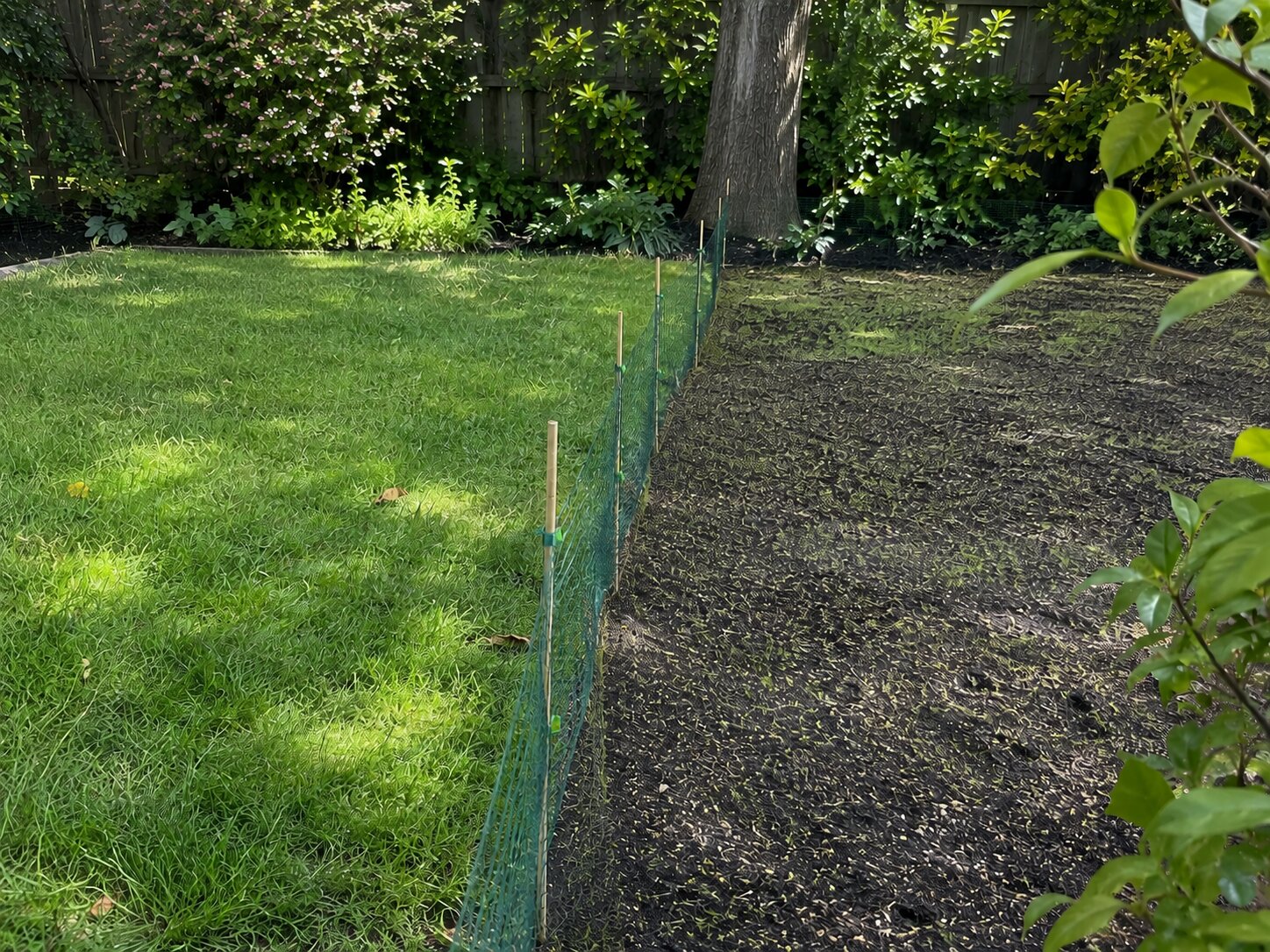
- Keep the dogs off it. Three weeks minimum, six is better. This is the hardest step and the one that decides the outcome. Fence it temporarily, gate it, or seed in halves and let them use the other half while the first establishes. A dog on a two-week-old lawn undoes the whole sowing in an afternoon.
Ongoing
Mow at 2–4 inches. Higher than a conventional lawn. Longer leaf means deeper roots, and deeper roots means better urine and drought tolerance.
Overseed each autumn in the areas that take the most traffic. RTF self-repairs, but giving it help costs almost nothing.
Do not fertilise. The clover handles it, and added nitrogen on top of dog urine is the fast route to burn.
When to sow
Autumn first, and the South is welcome here
Tall fescue tolerates warm zones far better than fine fescue — this is one of the very few products in our range that works properly in Zones 8 and 9.
| Zone | Window | Notes |
|---|---|---|
| 3–5 | Aug–Sep, or Apr–May | Autumn for fall establishment |
| 5b–7 | Aug–Sep | Peak performance. RTF rhizome activity is highest in warm soil |
| 7b–9 | Sep–Oct | Warm zones do best with later autumn sowing |
What to expect
Week two is when refunds happen. Both species are on schedule.
The most misread timeline in our range, because three species arrive at three different times.
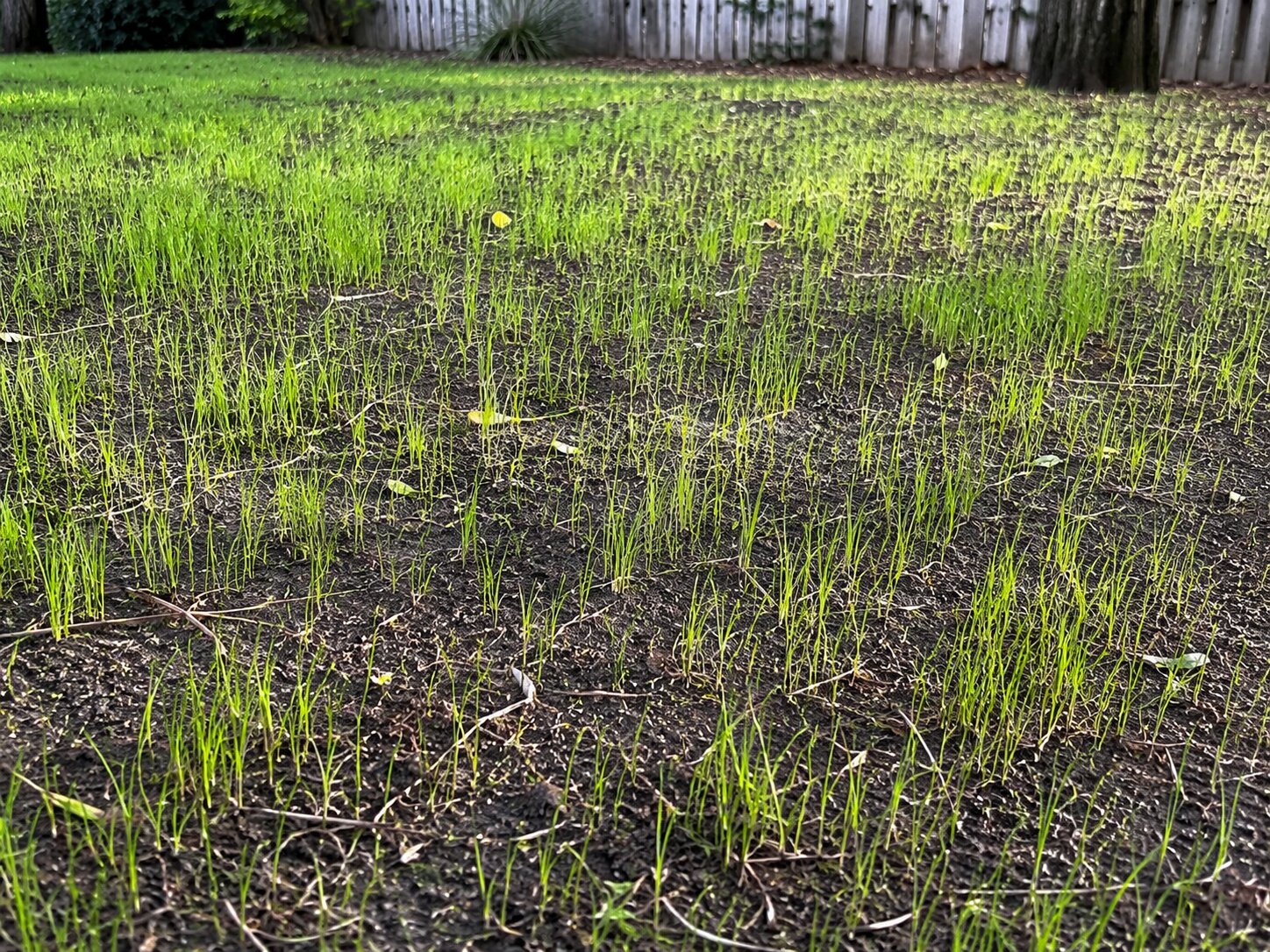
Season two is when it becomes a dog lawn. Before the rhizome network is established, it is a normal lawn that happens to contain the right species. The self-repair that makes it worth buying takes a full season to develop.
Questions
The safety questions, answered straight
Is grass good for dogs?
Yes — better than artificial turf on temperature, drainage and paw comfort. Living grass stays cooler in sun, drains urine into soil rather than pooling it, and repairs itself.
What matters more than the species is what you put on it. A lawn that needs no herbicide or fertiliser removes most of the exposure question entirely.
Is weed and feed safe for dogs?
Combination products contain a broadleaf herbicide plus fertiliser, and the label specifies a re-entry interval — read it and follow it for the specific product you have.
The better answer is a lawn dense enough not to need it. Clover fixes its own nitrogen and a thick mixed sward suppresses most weeds, which removes the question rather than managing it.
Is grass seed safe for dogs?
Yes. All species in our dog products are ASPCA-confirmed non-toxic. The hazard people read about is grass awns — barbed seed heads from ornamental and pasture grasses that work into paws and ears. Lawn grass mown at 2–4 inches never sets seed heads.
Is clover safe for dogs?
Yes. ASPCA lists Trifolium repens as non-toxic to dogs, cats and horses. Grazing on it is normal and harmless.
Can dogs eat clover?
In the quantities a dog grazes, yes. It is non-toxic and many dogs pick at it.
Can dogs pee on turf?
On living lawn, yes — with species that tolerate the salt and spread laterally to repair the damage. On artificial turf it needs rinsing, because there is no soil to drain or process it.
Is astro turf good for dogs?
It has no chemicals, which is the genuine appeal. Against that: it holds heat badly in summer, does not drain urine without rinsing, harbours odour, and never repairs itself.
A living lawn built for dogs addresses the same problems without those trade-offs, and costs a fraction as much per square foot.
How do I grow grass with dogs?
Sow in autumn, keep them off it for at least three weeks, and keep repair seed on hand. The keeping-off is what decides it — everything else is ordinary lawn practice.
How do I keep dogs off a newly seeded lawn?
Fence it temporarily with garden netting and canes, or seed in halves and let them use the other half. Three weeks minimum, six if you can manage it.
Is TruGreen safe for pets?
Not our product, so we cannot speak for their programme — check directly with them. The reason people ask is exactly the reason a self-feeding lawn appeals: fewer applications means fewer questions.
What causes the yellow patches?
Nitrogen burn from concentrated urine. The centre dies and the ring around it often grows darker green, because the diluted edge acts as fertiliser.
Species with salt tolerance and lateral spread reduce it; repair seed fixes what gets through. It is manageable rather than eliminable — any lawn with a dog on it will show some.
Do female dogs cause more damage?
The commonly cited reason is squatting produces a concentrated single spot rather than a spread. The concentration is what burns, so posture matters more than sex.
Will the lawn ever stop having patches?
Not entirely. What changes is the recovery speed — once the RTF rhizome network is established in season two, patches close on their own within weeks rather than persisting until you reseed.
Can I use this in Zone 8 or 9?
Yes. DogLawn is rated Zones 3–9, and tall fescue handles southern summers far better than the fine fescues in the rest of our range. Sow September to October.
Why buy from us
The strict rating, and the exclusions named
Non-GMO, USA-grown seed. Every species ASPCA-confirmed non-toxic — the strict rating, not the weaker “not listed toxic”, and we exclude the twelve products in our own catalogue that do not meet it. Three species chosen for three distinct jobs rather than a single grass sold as tough. Repair seed in every kit.