
Elfin Thyme Lawn
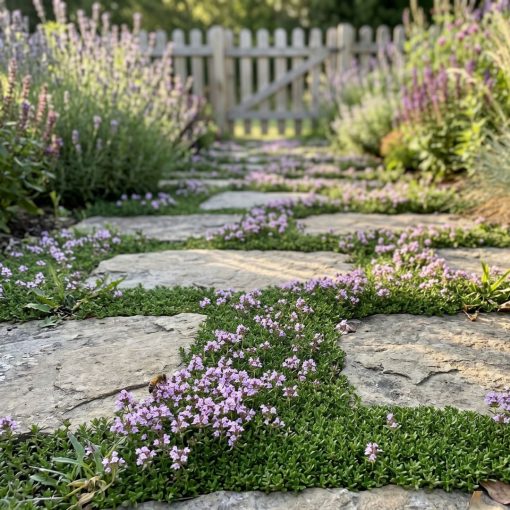
Low, fragrant planting for the gaps between pavers and the paths you cross. Measure the widest gap first — that number picks the plant, and it is the only measurement that matters.

Sizing
Size your path
Add a row per stretch — the paver run, the gravel court, the open path — and give each its own product: ElfWalk in the tight joints, PathScent across the surface, Sagina in the shaded end. Every bag is sized from its product page’s coverage table.
Paver gaps: measure the widest, not the average. The widest gap decides what will root.
The defining question
How wide are the gaps, and how often are they crossed?
Measure the widest gap
Not the average. Take a tape to the biggest gap in the run and measure it in inches — that is what has to support a root system, and a plant that suits your narrowest joint will look lost in the widest.
| Gap width | What works | What will fail |
|---|---|---|
| Under 1 inch | Moss, or nothing | Every seed — there is no root room or soil volume |
| 1–3 inches | Elfin thyme · wooly thyme · Sagina | Standard creeping thyme — too vigorous, it mounds over the paver edge |
| 3+ inches | Any creeping thyme, path mixes | — |
| Whole path surface | Steppable path mix | Grass of any kind |
Why standard thyme fails in a tight joint is worth stating, because it is counter-intuitive. It is not too weak — it is too strong. Red creeping thyme spreads 12–18 inches per plant and grows to 2–4 inches tall. In a one-inch joint it mounds up over the paver, gets scuffed by shoes, and looks unkempt within a season.
Elfin grows to 2–3 cm — about one inch — and spreads 12–18 inches per plant. It fills the same gap and stays flush with the stone.
Count the crossings
| Crossings | What works |
|---|---|
| A few times a week | Any creeping thyme |
| Daily, one route | Elfin thyme — “the most traffic-tolerant: individual stems are shorter and better protected underfoot” |
| Many times a day, same line | Nothing. Pave it |
And the two non-negotiables
Six hours of sun. ElfWalk’s own soil table: “Full sun — 6+ hours essential. Will not establish in shade.”
Sharp drainage. “Excellent drainage required. Elfin thyme rots in wet conditions faster than other varieties.” Lean, gritty, sandy or rocky preferred; heavy clay needs amending first.
pH 6.0–8.0 — thyme tolerates slightly alkaline soil and limestone, which suits most paving substrates and mortar residue. This is one of the few plants that is happier next to concrete than most.
Before you sow
Why path plantings fail
The gaps are too narrow
Under an inch there is no root room and no soil volume to hold moisture through a dry spell. Seed germinates and dies at the first hot week.
Fix: moss, gravel, or accept bare joints. Widening a joint is usually not practical once the paving is laid.
Wrong thyme for the gap
Standard creeping thyme in a one-inch joint mounds over the paver edge and gets scuffed off.
Fix: match cultivar to gap width. Elfin for tight joints, standard for open ones, and both in the same path if the gaps vary.
Walked on before it knits
“‘Elfin’ is the slowest-establishing creeping thyme from seed.” Germination takes 14–28 days against 7–14 for other thymes, and meaningful coverage takes into the second year. Foot traffic during that period opens gaps faster than the thyme closes them.
Fix: keep off it for the first season. Lay temporary stepping boards if the route is essential, or plant the path in halves and use one side while the other establishes.
The one we cannot fix: a path people genuinely use daily will not hold a living surface
Thyme takes light footfall. A route to the bins, the car or the back gate — used four or five times a day, always on the same line — compacts the soil and shears the stems faster than any plant recovers.
That is a paving problem, not a planting problem. Plant either side of it and pave the line people actually walk. A desire line is not negotiable by planting.
Choose your path planting
Tight gaps — 1 to 3 inches
ElfWalk · Thymus serpyllum ‘Elfin’ · 6+ hours · Zones 4–9 · $8.99 / 62 sq ft → $171.99 / 1,250 sq ft.
| Height | 2–3 cm — about 1 inch |
| Spread per plant | 30–45 cm — 12–18 inches |
| Bloom | Pale lavender-pink, June–July |
| Traffic tolerance | Highest of all creeping thymes |
“All creeping thymes are low-growing, but ‘Elfin’ is in a category of its own. At 2–3 cm it grows approximately half the height of red creeping thyme and wild thyme. The leaves are tiny — smaller than a match head — and the stems interlock into a dense cushion that hugs the ground more closely than any other variety.”
The spread figure is the planning number. At 12–18 inches per plant, seed sown into a joint will eventually fill roughly a foot in each direction. That is why a small quantity goes a long way in paver gaps and why patience beats over-sowing.
Rated ideal for six applications: paver gaps, stepping stone paths, gravel areas — “establishes in gravel gardens and dry courtyards where grass will not grow” — rock gardens, path edges, and small defined areas “where a wilder thyme like SilkWalk or ThymeWalk might spread too far.”
Never mow it. “None required. Never mow — the ultra-dwarf habit is the product.”
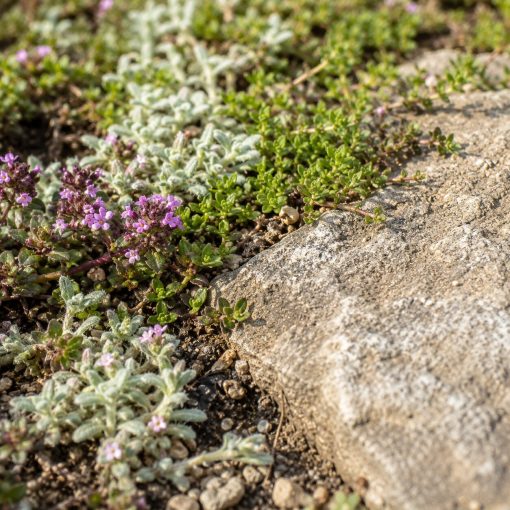
WoolWalk · Thymus pseudolanuginosus · 6+ hours — “very low and soft; takes light foot traffic.” Silver-grey woolly foliage, an entirely different texture beside the green thymes. Note it “rots in damp shade” even more readily than elfin.
Shaded paths — Sagina
EmeraldMoss and GoldenMoss · Sagina subulata · 2+ hours · Zones 4–8 · $14.99 / 30 sq ft → $79.99 / 250 sq ft.
Irish and Scotch moss. Not thyme, not moss, and not for the same conditions — they are flowering plants that look like moss and want cool, evenly moist, part-shade ground and the damp joints between paving. Emerald green and bright chartreuse respectively. “The sweet spot — even moisture out of harsh midday sun.”
Choose your path planting
The whole path surface
PathScent · three-thyme steppable mix — red, elfin and wooly · 6+ hours · $12.99 / 100 sq ft → $129.99 / 3,000 sq ft new (6,000 overseeding).
“Red, elfin and wooly knit into a low, drought-tolerant mat that takes light foot traffic, flowers for pollinators, and releases fragrance whenever it is brushed.”
The cheapest thyme route by a wide margin and the practical choice for covering a whole path area rather than filling individual joints. The three cultivars establish at different rates, so the faster ones hold the ground while elfin catches up.
PathScent’s Large bag covers 3,000 sq ft new — 6,000 overseeding. For any path over a few hundred square feet, this is straightforwardly the better buy. → Bulk creeping thyme
Choose your path planting
Mixing textures
The approach ElfWalk’s own FAQ recommends: “use ElfWalk in paver gaps and path areas where foot traffic is heaviest, and ThymeWalk or SilkWalk in the wider lawn areas. The varieties complement each other visually and bloom at slightly different times.”
| Variety | Height | Character | Traffic |
|---|---|---|---|
| ElfWalk | 1 in | Tightest, flattest, slowest | Highest |
| WoolWalk | 1–2 in | Silver-grey, woolly | Light |
| CarpetWalk | 2 in | “Low, tidy, tolerant of light stepping” | Light |
| MotherWalk | 2–3 in | “Spreads into a durable, fragrant low mat” | Light |
| WireWalk | 2 in | Breckland thyme — “loves gritty, sharply drained soil” | Light |
| ThymePalette | mixed | Four cultivars in one bag | Light |
The staggered bloom is a real benefit rather than a marketing line — elfin flowers June to July, red creeping thyme May to July, and mixing them extends the display by several weeks.
Flowering accents
English Daisy and Self-Heal both tolerate being walked on and flower at low height.
Yaak Yarrow — flowering, drought tolerant and rhizomatous, but not on the ASPCA safe list. If pets use the path, choose the other two.
The kits
The basket a customer built unprompted
Yaak Yarrow + ElfWalk + English Daisy + Self-Heal. Assembled by someone with no page suggesting it, and the only repeated co-purchase pattern in our order history. If pets use the path, untick the yarrow — English Daisy and Self-Heal are both ASPCA-confirmed; yarrow is not.
Method
Three situations, three methods
All surface-sow: “elfin thyme seed requires light for germination. Any soil covering will significantly reduce germination rates.”
Paver gaps
- Remove existing weeds and debris from the gaps — right down, not just the surface.
- Fill with a sharp sand and compost mix to 2 cm below the paver surface. The recess matters: it holds the seed and stops it washing out, and it gives the plant somewhere to sit flush rather than proud.
- Scatter seed, press firmly, mist to settle.
Bare ground — a whole path area
- Clear all vegetation. Rake to a fine tilth.
- Scatter evenly, roll or tamp for contact.
- Mist daily for 3–4 weeks — longer than any other product on this site, because elfin germinates slowly and the surface must not dry in that window.
Gravel
- Pull back the gravel to expose soil in the target areas.
- Sow on the exposed soil.
- Pull the gravel back lightly around the seed, not over it.
Gravel is a genuinely good medium for thyme — sharp drainage, warm surface, and the stones hold seed in place. “Establishes in gravel gardens and dry courtyards where grass will not grow.”

Soil and aftercare
Lean, gritty, sandy or rocky. Avoid heavy clay without amendment. pH 6.0–8.0.
Drought-tolerant once established — regular watering during the establishment year only. After that, watering it is more likely to harm than help.
Never mow. The dwarf habit is the product.
When to sow
Soil at 60°F
| Zone | Window | Notes |
|---|---|---|
| 3–4 | Apr–May at 60°F soil | Cold-hardy; dies back in hard winters, recovers in spring |
| 4–6 | Apr–May or September | Most reliable performance |
| 6b–8 | Spring or autumn | Longest bloom, evergreen through winter |
| 8b–9 | Spring, with sharp drainage | Water occasionally in peak heat |
ElfWalk is rated Zones 4–9 rather than 3–9 — slightly less cold-hardy than red creeping thyme. In Zone 3, use ThymeWalk or SilkWalk. Sagina differs: Zones 4–8, spring sowing into consistently moist ground.
What to expect
The slowest establishment of anything we sell
Stated up front, because the alternative is a refund request at month two.
“‘Elfin’ is the slowest-establishing creeping thyme from seed. Its dwarf habit means initial growth is very gradual. Do not expect rapid coverage — the payoff is the densest, flattest mat available once established.”
Three seasons is the honest answer for elfin, and end of year one is 5–10 cm plants with soil between them. That is on schedule, not a failure.
If you want it filled in faster, use SilkWalk or ThymeWalk — both reach coverage in two seasons. Or use PathScent, whose faster cultivars hold the ground while the elfin catches up. This is the single most important expectation on the page, and it is why we put it in the product description as well as here.
Looking for
What people are actually looking for
Nobody asks questions about path planting — they describe what they want. Here is what each description actually resolves to.
Steppable ground cover
Thyme for sun, Sagina for shade. Both take light footfall; neither takes a daily route.
Walkable ground cover
The same plants, and the honest boundary is walkable rather than walked on. A surface you cross occasionally, not a thoroughfare.
Walkable ground cover for shade
Irish or Scotch moss. Thyme will not do it. It is the mismatch that costs the most seasons — getting it wrong loses a year.
Creeping thyme pathway
PathScent for the whole surface, ElfWalk for the joints between stones. Both if the path has stones set into a planted surface.
Best steppable ground cover
Depends entirely on gap width and light. Under an inch and shaded: moss. One to three inches in sun: elfin thyme. Wider: anything.
Drought-tolerant walkable ground cover
Thyme, comfortably. “Highly drought-tolerant once established, thriving in lean, sunny, sharply drained ground where grass struggles.”
Steppable ground cover full sun
Elfin, wooly or a path mix. Full sun is what thyme wants; the constraint is drainage rather than light.
Ground cover between pavers
Measure the gap first. The widest joint decides what will root — the bands are at the top of this page.
California native ground cover walkable
Thyme is not native to California, though it suits the Mediterranean climate well. For natives specifically, a regional supplier will serve you better than we can.
How to plant creeping thyme between pavers
The paver-gap method above: sharp sand and compost to 2 cm below the surface, scatter, press, mist.
Low growing ground cover for pathways
Elfin at one inch is the lowest we sell. Sagina is similar in shade.
Why buy from us
Cultivars by name, timelines told straight
Non-GMO, USA-grown seed. Cultivars listed by name, height, spread and traffic tolerance, so you can match the plant to the gap rather than guessing from a photograph. And honest timelines: elfin thyme takes three seasons and we say so in the product description, on this page, and in the FAQ — because a customer who knows that is a customer who is pleased in year three rather than disappointed in month two.