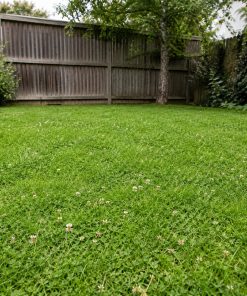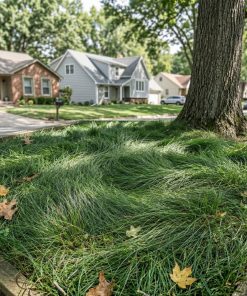
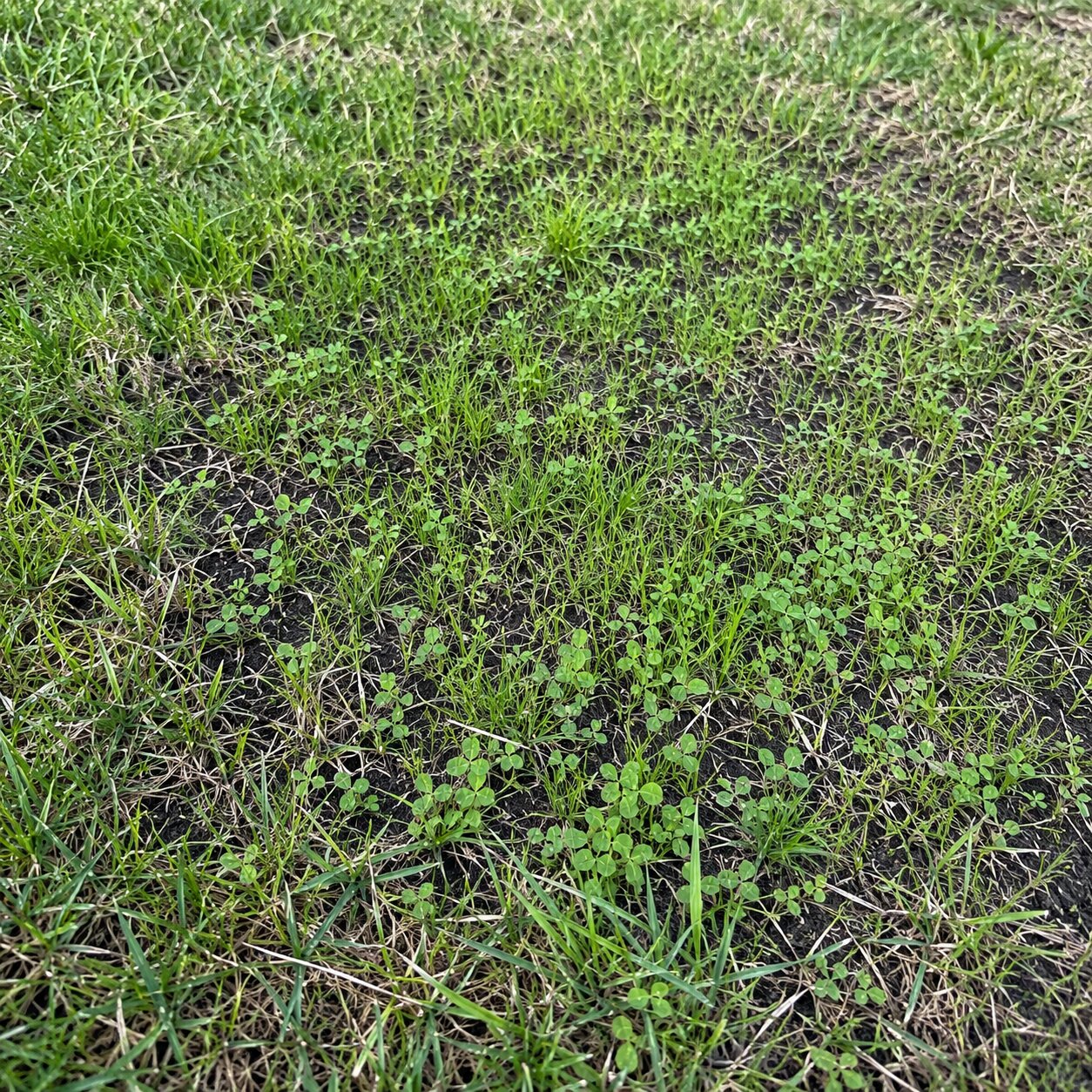

Description
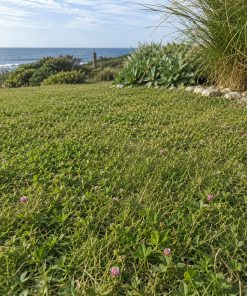
Bare-Spot & Overseed Repair Mix is the fix-it blend. Fast-germinating white clover fills gaps and spreads into worn areas while fine fescue knits a fine-textured turf around it — so bare spots close and tired lawns thicken in a single season, with clover feeding the whole area as it goes.
Seed specifications
| Species | Common name | Leaf / blade | Zone | Height | Bloom | ASPCA |
|---|---|---|---|---|---|---|
| Trifolium repens | White clover | 8–15 mm leaf | 3–10 | 4–8 in (2–4 mowed) | White, May–Sep | Non-toxic |
| Festuca spp. (fine) | Fine fescue | Fine blade | 3–8 | 5–9 in unmowed | Insignificant | Non-toxic |
ASPCA: Trifolium repens (white clover) is not on the ASPCA list of plants toxic to dogs and cats.
Why choose Bare-Spot & Overseed Repair Mix
White clover germinates quickly — typically within 7–10 days — and spreads by stolons to cover bare soil, which makes it ideal for patching. Fine fescue fills in around it with a fine, low-input turf, and because clover fixes nitrogen, the repaired area greens up without a heavy feeding programme.
The mix is designed to overseed straight into an existing lawn: mow low, scratch up thin and bare areas, broadcast, and keep moist. University of Maryland Extension notes that adding clover to a lawn improves density and reduces fertiliser needs, which is why an overseeded stand thickens over the season.
It is the accessible way to improve a lawn without a full renovation — no killing off the old turf, just broadcasting into it. For a whole-lawn overhaul, pair it with one of our full eco-lawn mixes.
Best uses
| Application | Suitability | Notes |
|---|---|---|
| Repairing bare spots | Excellent | Fast germination fills gaps in one season. |
| Overseeding thin lawns | Excellent | Blends into existing grass; no full renovation. |
| Reducing fertiliser | Very Good | Added clover feeds the lawn naturally. |
| Pet-worn patches | Very Good | Soft clover fills and self-repairs high-use areas. |
| Sun to light shade | Very Good | Best in sun; tolerates some shade. |
| Deep shade repair | Poor | Needs some sun; use a shade mix under dense canopy. |
This eco-lawn mix vs a conventional grass lawn
| Property | This eco-lawn mix | Conventional grass lawn |
|---|---|---|
| Fertiliser | Clover fixes nitrogen — little or no synthetic feed | Regular synthetic nitrogen |
| Water need | Lower once established | Higher, especially in summer |
| Mowing | Less frequent, mow high | Frequent through the season |
| Pollinators | Supports bees where it flowers | Little to no value |
| Wear | Good with the right mix | Good |
| Inputs and cost | Lower over time | Higher over time |
Zone & climate compatibility
| Zone | Performance | Notes |
|---|---|---|
| Zone 3–5 | Excellent | Cold-hardy; sow Apr–May once soil hits ~50°F. Stays fine and tight in cool seasons. |
| Zone 5b–7 | Excellent | Best overall performance. Autumn sowing (Aug–Sep) gives the strongest first-season stand. |
| Zone 8–9 | Very Good | May idle in peak summer heat and recover in autumn; a light autumn overseed keeps density. |
How to sow Bare-Spot & Overseed Repair Mix
- Prepare a firm, weed-free seedbed. Rake to a fine, level surface. For overseeding, mow the existing lawn to 1.5–2 in and scratch up thin or bare areas so seed reaches the soil.
- Broadcast at the right rate. Sow at about 1– per 1,000 sq ft for a new lawn, or ½– per 1,000 sq ft to overseed. Cross-sow half the seed in a second direction for even cover.
- Keep seed shallow. Rake lightly for soil contact and roll or tamp; do not bury fine clover and fescue seed — it needs light contact with the surface.
- Water lightly and often. Keep the surface consistently moist with one or two light waterings a day until seedlings appear — typically 7–14 days for fescue and clover.
- Hold the first mow. Let seedlings reach 3–4 in and root in before the first cut, then mow high (2.5–3 in) through the first season.
- Sow in the right window. Early autumn is ideal in most regions; spring works where summers are mild. Aim for soil temperatures of about 50–65°F.
Care & maintenance
- Mow high and rarely. Keep the blade at 2.5–3.5 in; taller growth shades soil, holds moisture, and crowds out weeds.
- Skip the nitrogen. The clover fixes its own; over-feeding with synthetic nitrogen favours grass and weeds over clover.
- Water deeply, not often, once established to encourage deep roots.
- Top-up overseed each autumn in high-traffic or hot-summer areas to keep the stand dense.
Sources
- University of Maryland Extension — white clover in lawns: extension.umd.edu
- University of Minnesota Extension — low-input and bee lawns: extension.umn.edu
- ASPCA — toxic and non-toxic plants (white clover): www.aspca.org
- USDA PLANTS Database: plants.usda.gov
Related seed: Finefolio Microclover Hearthclover White Dutch Clover Groundkeep No Mow Lawn
Learn more: White Dutch clover lawn guide Does white clover fix nitrogen?
Explore more: Shop all eco-lawn seed Compare seed by need