
Description
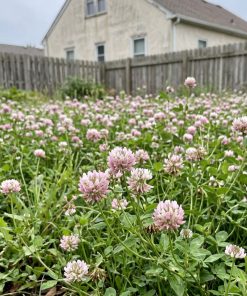
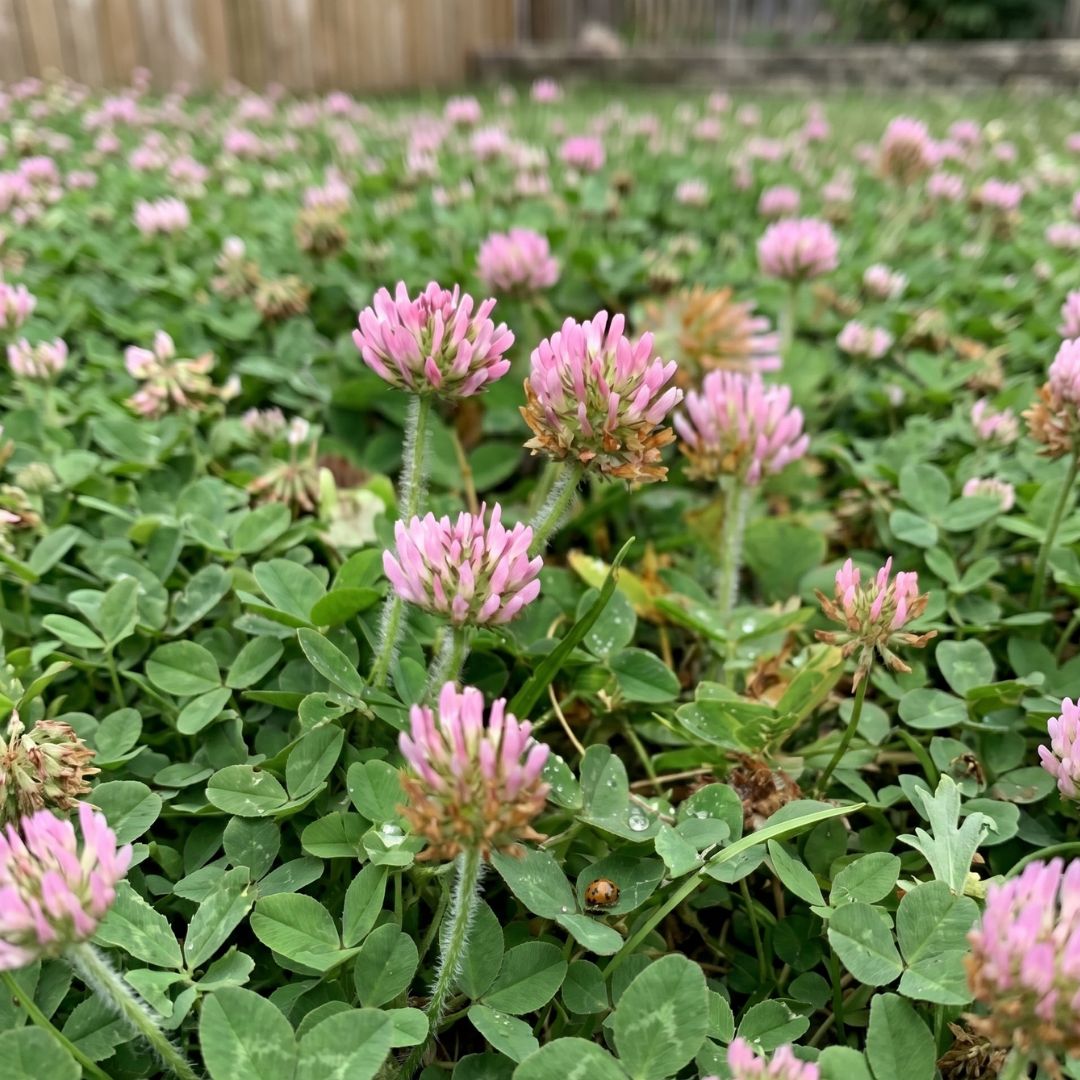
StrawberryField is a premium strawberry clover lawn seed — non-GMO, USA-grown Trifolium fragiferum that establishes a low-growing, nitrogen-fixing strawberry clover lawn with distinctive pink ball-shaped blooms from June through September. Uniquely tolerant of saline soils, periodic flooding, and drought, strawberry clover lawn seed thrives in conditions where most alternatives fail. A hardy perennial across Zones 3–9, requiring only 2–4 mowings per year once established.
StrawberryField Strawberry Clover Lawn Seed Specifications
| Species | Common Name | Zone | Height | Bloom | Mowing | ASPCA |
|---|---|---|---|---|---|---|
| Trifolium fragiferum | Strawberry Clover | 3–9 | 2–4 in unmowed | Jun–Sep | 2–4× per year | Non-toxic |
ASPCA confirmed: Trifolium fragiferum (strawberry clover) is non-toxic to dogs, cats, and horses per ASPCA Animal Poison Control.
Why Choose Strawberry Clover Lawn Seed
Strawberry clover (Trifolium fragiferum) is the most stress-tolerant clover species available for lawn use. UC Cooperative Extension documents T. fragiferum as uniquely adapted to saline soils, periodic flooding, and extended drought — conditions that kill white Dutch clover and defeat most grass species. For homeowners with heavy clay, alkaline soils, coastal zones, or yards prone to seasonal waterlogging, strawberry clover lawn seed fills a site requirement that no other clover product addresses.
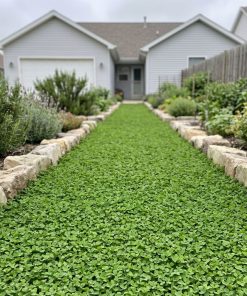
Like all clovers, strawberry clover fixes atmospheric nitrogen via Rhizobium root nodules, reducing or eliminating synthetic fertiliser requirements. Its bloom resembles a small pink strawberry — compact, rounded, and attractive — making a strawberry clover lawn visually distinctive without the tall, floppy appearance of red clover. At 2–4 inches unmowed, the growth habit is naturally low and dense. UC Davis documents it as highly competitive against weeds once established, forming a tight mat that resists invasion better than white Dutch clover in warm, dry summers.
Strawberry clover is also one of very few lawn alternatives that performs reliably in both the arid West and the humid Southeast — making it the correct choice for Zones 7–9 where white clover often struggles in peak summer heat.
Best Uses for StrawberryField Strawberry Clover Lawn Seed
| Application | Performance | Notes |
|---|---|---|
| Saline or alkaline soil lawns | Excellent | The defining advantage of strawberry clover over all other lawn clovers. UC Cooperative Extension confirms tolerance of high-salt and alkaline conditions where white Dutch clover fails. |
| Drought-prone or dry-summer lawns | Excellent | Deep root system sustains the lawn through summer drought better than white Dutch clover. Particularly well suited to Zones 7–9 and western states. |
| Seasonally wet or flood-prone areas | Excellent | Tolerates periodic waterlogging and poorly drained areas. One of very few lawn alternatives suitable for low-lying sites. |
| Nitrogen-fixing lawn — reducing fertiliser | Excellent | Fixes atmospheric nitrogen via Rhizobium root nodules. Equivalent benefit to other Trifolium species. Most customers reduce or eliminate synthetic fertiliser in year one. |
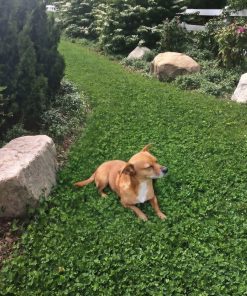
| Pet-friendly lawn | Excellent | ASPCA confirmed non-toxic to dogs, cats, and horses. Low-growing and soft underfoot. Dense mat handles moderate pet traffic well. |
| Overseeding into existing grass | Very Good | Broadcast directly into existing turf without removal. Integrates well with warm-season grasses in Zones 7–9. Full blending in one season. |
| Deep shade sites | Poor | Requires a minimum of 4 hours of direct sun daily. In full shade, strawberry clover thins and fails. For shade alternatives see Shade Lawn Guide → |
Strawberry Clover vs White Dutch Clover
| Property | StrawberryField Strawberry Clover | HearthClover White Dutch |
|---|---|---|
| Species | Trifolium fragiferum | Trifolium repens |
| Unmowed height | 2–4 inches | 6–8 inches |
| Saline soil tolerance | Excellent | Poor |
| Wet soil tolerance | Excellent | Moderate |
| Drought tolerance | Excellent | Good |
| Pollinator value | Good | Excellent — 80+ bee species |
| N-fixation | Equal — same genus | Equal — same genus |
| Best for | Saline, wet, dry, or coastal sites | Maximum pollinators, general lawns |
Zone & Climate Compatibility
| Zone | Performance | Notes |
|---|---|---|
| Zone 3–5 | Excellent | Cold-hardy perennial. Dies back in winter; reliable spring recovery. Seed Apr–May when soil reaches 50°F. |
| Zone 5b–7 | Excellent | Peak performance. Longest bloom season. Seed spring (Apr–May) or fall (Aug–Sep). Outperforms white Dutch clover on heavy or alkaline soils. |
| Zone 8–9 | Excellent | Outperforms white Dutch clover in hot, dry summers. Maintains density through heat and drought. Seed Oct–Nov for best Zone 8–9 establishment. Top-up overseed each fall to maintain density. |
How to Plant Strawberry Clover Lawn Seed
Strawberry clover germinates in 7–14 days at soil temperatures of 50–65°F. Seed in spring (Apr–May) or fall (Aug–Sep) in Zones 3–7. In Zones 8–9, fall seeding (Oct–Nov) gives best establishment results.
- Prepare or mow short. For bare soil, rake smooth and firm lightly. For overseeding, mow existing grass to 1.5–2 inches and rake out any thick thatch.
- Broadcast at the surface. Sow per 1,000 sq ft for new lawns. For overseeding, sow per 1,000 sq ft. Do not bury — strawberry clover seed is tiny and requires light surface contact to germinate.
- Rake lightly for soil contact. A single pass with a leaf rake is sufficient. Do not cover deeply.
- Water lightly and consistently. Keep the surface moist with two light waterings per day for the first 10–14 days until germination. Do not let the surface dry between waterings.
- Hold mowing for 4–6 weeks. Allow seedlings to root fully before the first mow. Set blades to 3 inches minimum in the first season.
- Mow 2–4 times per year. Strawberry clover requires minimal mowing. Mow after bloom cycles to tidy and encourage repeat flowering. In Zones 8–9, a light overseed each fall maintains density.
For full zone-by-zone planting timing and care, see our Clover Lawn Guide and Alternative Lawn Guide →
Sources
- UC Cooperative Extension — Trifolium fragiferum salt and flood tolerance, drought adaptation: ucanr.edu
- UC Davis Turfgrass Program — Strawberry clover as low-input lawn alternative (weed suppression, density): turfgrass.ucdavis.edu
- Penn State Extension — Clover in lawns, N-fixation rates across Trifolium species: extension.psu.edu
- ASPCA Animal Poison Control — Trifolium fragiferum non-toxicity: aspca.org
Related guides:
Single-species clover:
Multi-clover blends:
Clover-grass mixes: