
Lawn alternatives in Mississippi
Hot, humid and Deep South — Mississippi favours warm-season ground covers, with cool-season options only in the northern hills.
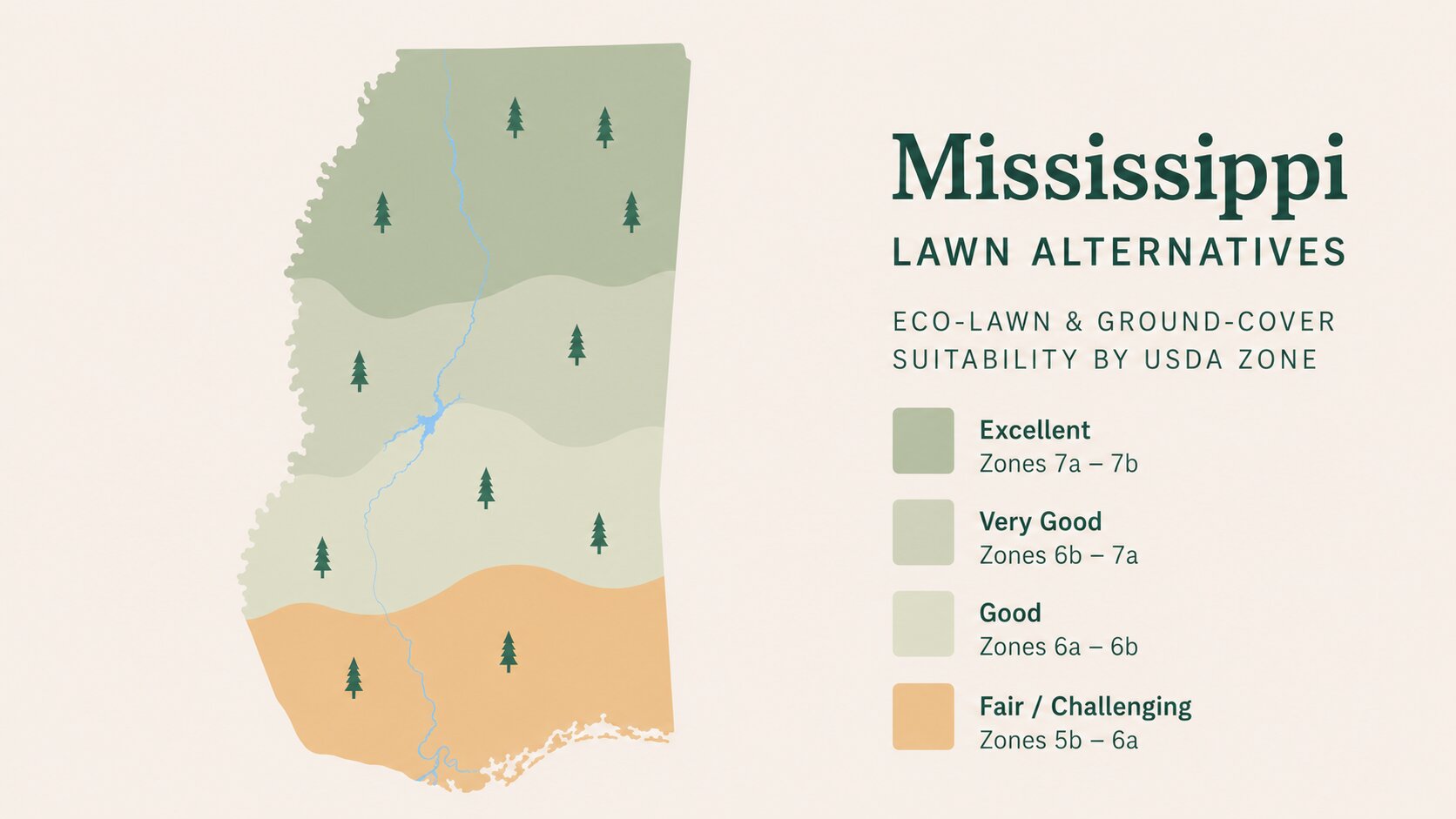
The short version
Mississippi sits in USDA zones 7b–9a. Below: the low-input lawns that genuinely suit the state’s climate, an honest note on what doesn’t, and where to go next — all matched to verified species data.
Know your zone first
Mississippi runs warm. Per the 2023 USDA Plant Hardiness Zone Map and Mississippi State University Extension, the state spans zone 7b in the northeastern hills to 9a on the Gulf Coast, with most of the state in 8a–8b.
It’s a humid subtropical climate: hot, humid summers and mild winters, turning near-tropical on the coast. That makes warm-season, heat-and-humidity-tolerant species the natural choice across most of the state.
| Part of state | USDA zones | Representative cities |
|---|---|---|
| North hills / Memphis metro | ~7b–8a | Olive Branch, Oxford, Tupelo, Corinth |
| Delta & central / Piney Woods | ~8a–8b | Jackson, Greenville, Starkville, Hattiesburg |
| Gulf Coast | ~9a | Biloxi, Gulfport, Pascagoula |
Zone data: 2023 USDA Plant Hardiness Zone Map (planthardiness.ars.usda.gov); Mississippi State University Extension (extension.msstate.edu). Species data from our Verified Data Layer.
Low-input lawns that suit Mississippi
Honest note: heat and humidity set the rules
Cool-season fine fescue only really works in the cooler far-north hills — it struggles through Mississippi’s long, humid summers further south. Creeping thyme needs excellent drainage to cope with the humidity, and buffalograss prefers drier climates than humid Mississippi. Lean warm-season, and match species to your part of the state.
Shop these for your climate
Getting it right here
North vs south. The cooler northern hills suit clover and a little fescue; the hot, humid Delta, Piney Woods and coast lean warm-season.
Choose for humidity. Fungal disease and heat decide success here — favour humidity-tolerant species and make sure beds drain well.
Time it right. Sow warm-season options in late spring; sow cool-season clover in fall.
Find your exact zone
Look up your ZIP at the USDA Plant Hardiness Zone Map, then match species using our zone reference and planting calendar.
Common questions for Mississippi
What USDA zone is Mississippi?
Do I need different species in north versus south Mississippi?
How does Mississippi’s humidity affect species choice?
When should I plant in Mississippi?
Plan your Mississippi lawn
Find your lawn alternative
Matched to your zone and site.
Nearby & similar-climate states
Planning across the region? Compare lawn-alternative guidance for Alabama, Arkansas, Louisiana, Tennessee.