
Lawn alternatives in Louisiana
Hot, humid and subtropical — Louisiana sits outside most of the temperate lawn world, so we'll be honest about what actually works.
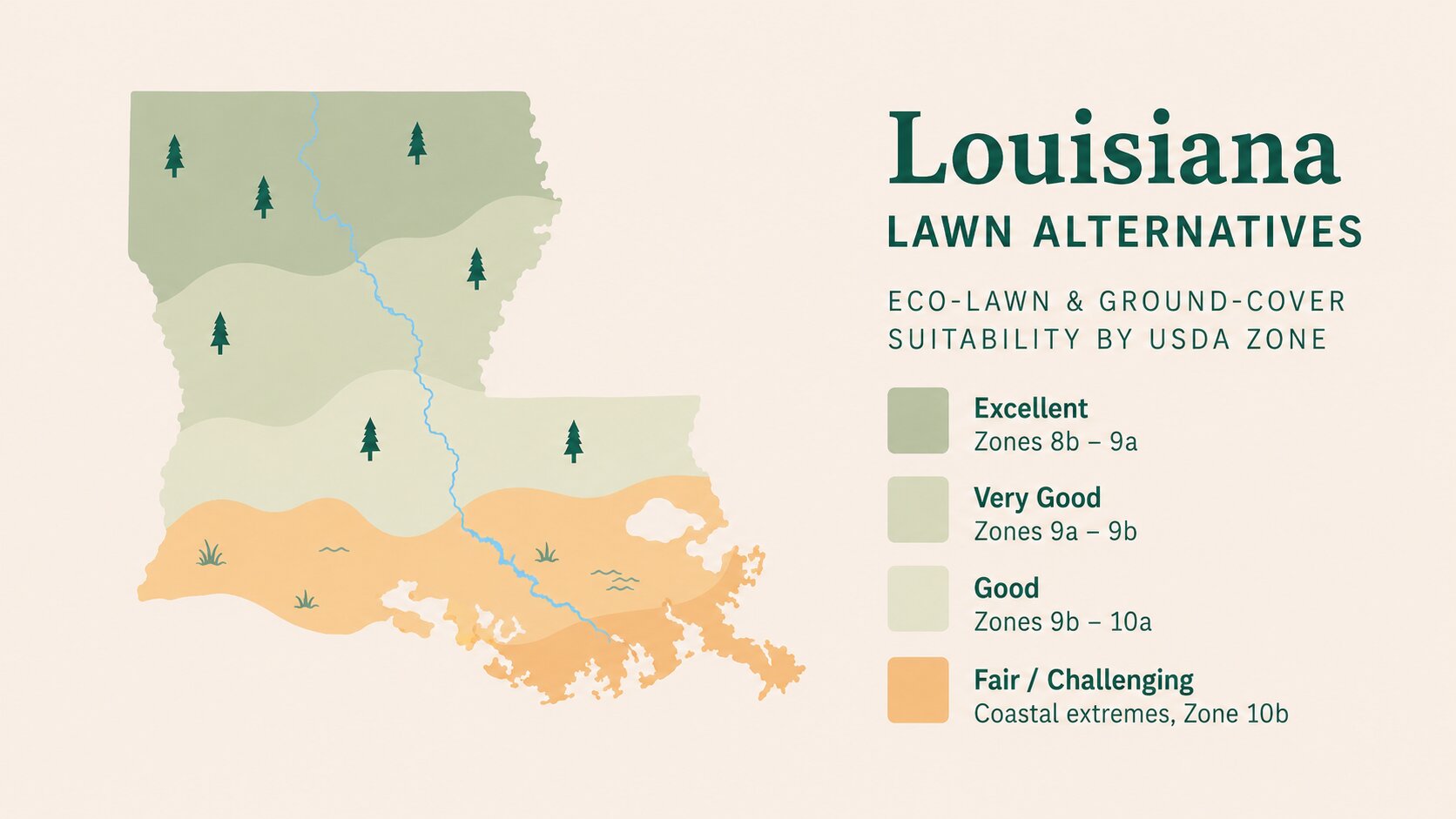
The short version
Louisiana sits in USDA zones 8b–10b. Below: the low-input lawns that genuinely suit the state’s climate, an honest note on what doesn’t, and where to go next — all matched to verified species data.
Know your zone first
Louisiana is warm all the way through. Per the 2023 USDA Plant Hardiness Zone Map and the LSU AgCenter, the state spans zone 8b in the north to 9b across the south, with 10a–10b on the Gulf coast — New Orleans sits in 9b.
This is humid-subtropical to nearly tropical: long, hot, humid summers, very mild winters and abundant rain. That climate puts Louisiana beyond most of our cool-season and Mediterranean species — heat, humidity and disease decide success here.
| Part of state | USDA zones | Representative cities |
|---|---|---|
| North Louisiana / Ark-La-Tex | ~8b | Shreveport, Monroe, Ruston |
| Central / Red River | ~9a | Alexandria, Natchitoches, Baton Rouge |
| South / Acadiana | ~9b | Lafayette, Lake Charles, New Orleans |
| Gulf coast | ~10a–10b | Houma, Venice, Grand Isle |
Zone data: 2023 USDA Plant Hardiness Zone Map (planthardiness.ars.usda.gov); LSU AgCenter (lsuagcenter.com). Species data from our Verified Data Layer.
Low-input lawns that suit Louisiana
Honest note: skip fescue, thyme and buffalograss
Cool-season fine fescue can’t survive Louisiana’s heat, creeping thyme rots in the humidity, and buffalograss prefers a drier climate — none suit this state. The dependable path is warm-season and Louisiana-adapted ground covers; the LSU AgCenter is the best local guide for heat- and humidity-tolerant choices.
Shop these for your climate
Getting it right here
Choose for humidity, not cold. Fungal disease and heat decide success — pick humidity-tolerant, Louisiana-adapted species.
Build your soil. Sandy uplands, heavy clay and delta soils all benefit from added organic matter.
You have a long season. Sow warm-season options in the warm months; in the south, growth barely pauses all year.
Find your exact zone
Look up your ZIP at the USDA Plant Hardiness Zone Map, then match species using our zone reference and planting calendar.
Common questions for Louisiana
What USDA zone is Louisiana?
Is cold hardiness a concern in Louisiana?
Does Louisiana’s soil need special attention?
When should I plant in Louisiana?
Plan your Louisiana lawn
Find your lawn alternative
Matched to your zone and site.
Nearby & similar-climate states
Planning across the region? Compare lawn-alternative guidance for Arkansas, Mississippi, Texas.