
Lawn alternatives in Minnesota
One of the coldest states in the Lower 48 — Minnesota is cool-season lawn country, where winter-hardiness is everything.
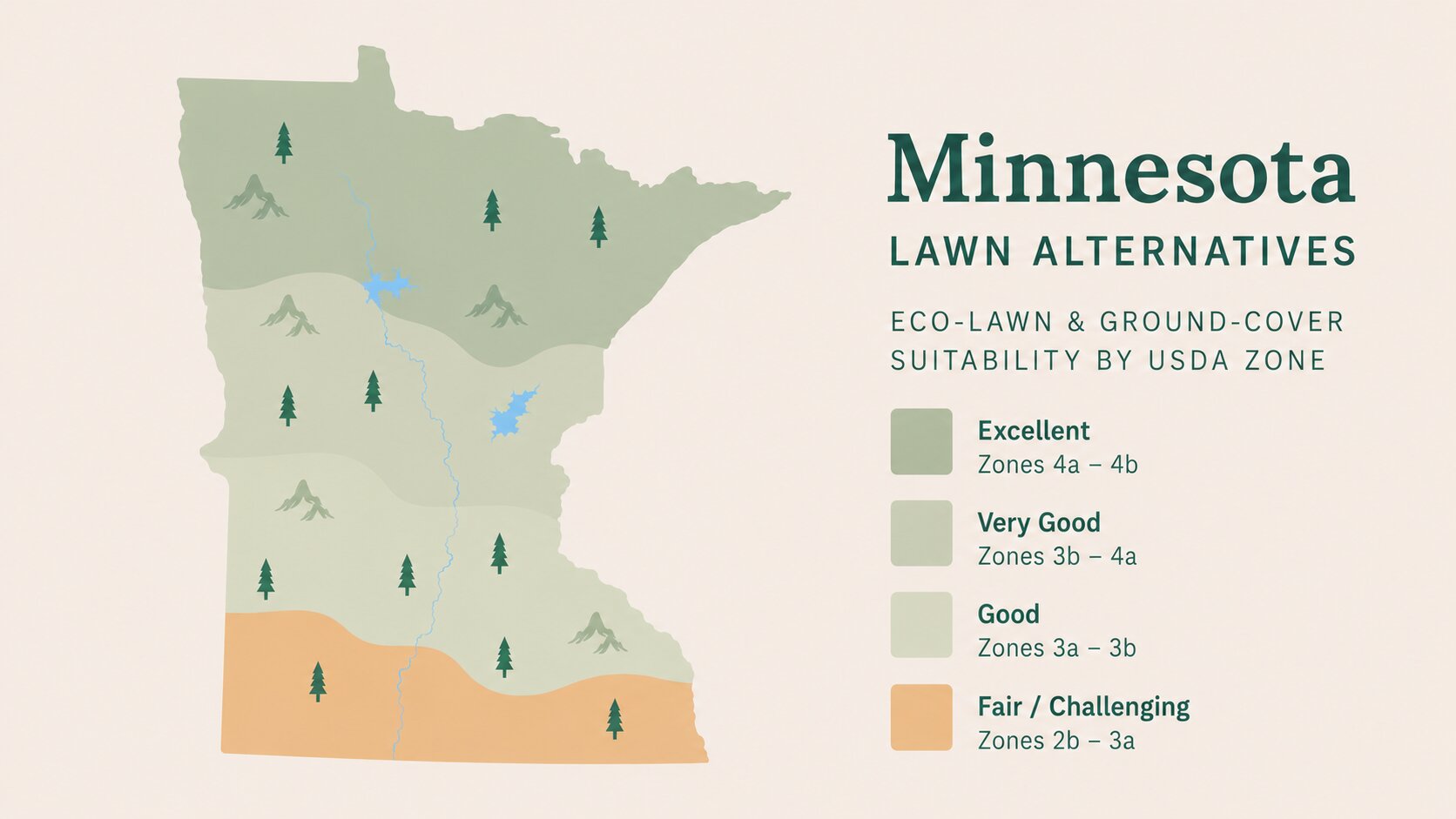
The short version
Minnesota sits in USDA zones 3a–5a. Below: the low-input lawns that genuinely suit the state’s climate, an honest note on what doesn’t, and where to go next — all matched to verified species data.
Know your zone first
Minnesota is defined by cold. Per the 2023 USDA Plant Hardiness Zone Map and University of Minnesota Extension, the state spans zone 3a in the far north to 5a in the south — the Twin Cities and Rochester now sit in 5a, while northern counties are among the coldest in the Lower 48.
It’s a harsh continental climate: long, snowy winters, short warm summers, and as few as 90 frost-free days up north. Here, winter cold-hardiness — not summer heat — decides what survives, and that means cool-season species, full stop.
| Part of state | USDA zones | Representative cities |
|---|---|---|
| Northern Minnesota | ~3a–3b | International Falls, Ely, Bemidji, Grand Marais |
| Central Minnesota | ~4a–4b | Brainerd, St. Cloud, Duluth (Lake Superior) |
| Southern MN & Twin Cities | ~4b–5a | Minneapolis, St. Paul, Rochester |
Zone data: 2023 USDA Plant Hardiness Zone Map (planthardiness.ars.usda.gov); University of Minnesota Extension (extension.umn.edu). Species data from our Verified Data Layer.
Low-input lawns that suit Minnesota
Honest note: cool-season only here
Minnesota’s extreme cold and short season rule out warm-season species across nearly the whole state — dichondra can’t survive, and buffalograss is marginal even in the warmest southwest prairie corner. Choose the hardiest zone-3 cool-season species, sow early so they establish before freeze-up, and lean on snow cover and good fall watering for winter survival.
Shop these for your climate
Getting it right here
North vs south. The brutally cold north (zone 3) needs the very hardiest cool-season species; the milder south and Twin Cities open up the full cool-season palette plus thyme.
Beat the freeze. Sow cool-season seed by late summer so it roots before winter; the northern window is short.
Shade is well covered. Native Pennsylvania sedge and fine fescue handle shade under Minnesota’s trees.
Find your exact zone
Look up your ZIP at the USDA Plant Hardiness Zone Map, then match species using our zone reference and planting calendar.
Common questions for Minnesota
What USDA zone is Minnesota?
How cold is northern Minnesota, really?
When should I plant in Minnesota?
What grows well in shade in Minnesota?
Plan your Minnesota lawn
Find your lawn alternative
Matched to your zone and site.
Nearby & similar-climate states
Planning across the region? Compare lawn-alternative guidance for Iowa, North Dakota, South Dakota, Wisconsin.