
Lawn alternatives in South Dakota
Cold prairie country — South Dakota is cool-season lawn territory, with native buffalograss a real option on the dry west.
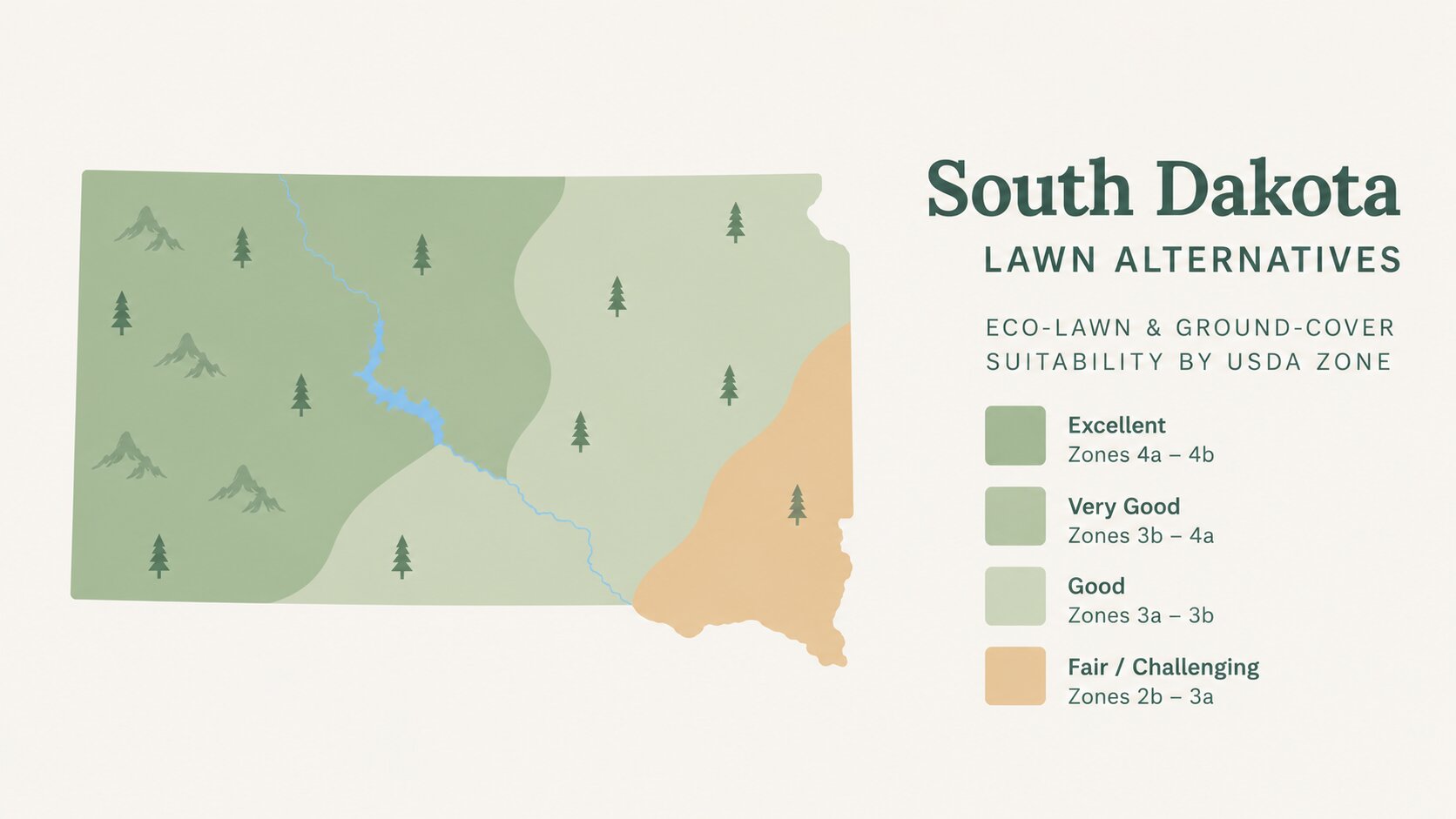
The short version
South Dakota sits in USDA zones 4a–5b. Below: the low-input lawns that genuinely suit the state’s climate, an honest note on what doesn’t, and where to go next — all matched to verified species data.
Know your zone first
South Dakota is cold-Plains through and through. Per the 2023 USDA Plant Hardiness Zone Map and SDSU Extension, the state spans zone 4a in the far north to 5b in the warmer south and Black Hills pockets — Sioux Falls sits around 4b–5a, Rapid City around 5a.
It’s a cold, semi-arid northern-Plains climate: bitter winters, hot summers, constant wind, and a short season. As in neighbouring Nebraska, a west-to-east moisture gradient — drier West River, wetter southeast — shapes what thrives alongside winter hardiness.
| Part of state | USDA zones | Representative cities |
|---|---|---|
| Northeast & Glacial Lakes | ~4a–4b | Aberdeen, Watertown, Sisseton |
| James River & east-central | ~4b–5a | Brookings, Huron, Mitchell |
| Southeast prairie / Sioux Falls | ~4b–5b | Sioux Falls, Yankton, Vermillion |
| West River & Black Hills | ~4a–5b | Rapid City, Spearfish, Custer |
Zone data: 2023 USDA Plant Hardiness Zone Map (planthardiness.ars.usda.gov); SDSU Extension (extension.sdstate.edu). Species data from our Verified Data Layer.
Low-input lawns that suit South Dakota
Honest note: cold north, drier west
South Dakota’s cold winters favour the hardiest cool-season species in the colder north and wetter southeast. On the drier West River and southern prairie — buffalograss’s native range — that warm-season native becomes a genuine low-water lawn, browning to tan outside summer. Dichondra can’t survive the winters, and the high Black Hills have a very short season.
Shop these for your climate
Getting it right here
North/east vs west. Lean cool-season (fescue, clover) in the colder north and wetter southeast; reach for buffalograss and thyme on the dry west.
Use the prairie heritage. Buffalograss is a true native here — give it full sun and expect a summer-only green-up.
Sow early. The Plains season is short and windy — get cool-season seed down in late summer or early spring.
Find your exact zone
Look up your ZIP at the USDA Plant Hardiness Zone Map, then match species using our zone reference and planting calendar.
Common questions for South Dakota
What USDA zone is South Dakota?
Does South Dakota split north-south or east-west?
Is buffalograss a genuine native to South Dakota?
When should I plant in South Dakota?
Plan your South Dakota lawn
Find your lawn alternative
Matched to your zone and site.
Nearby & similar-climate states
Planning across the region? Compare lawn-alternative guidance for Iowa, Minnesota, Montana, Nebraska, North Dakota.