
Lawn alternatives in Iowa
Cold, prairie, continental — Iowa leans cool-season, but its drier western ground also opens the door to a true native prairie grass.
The short version
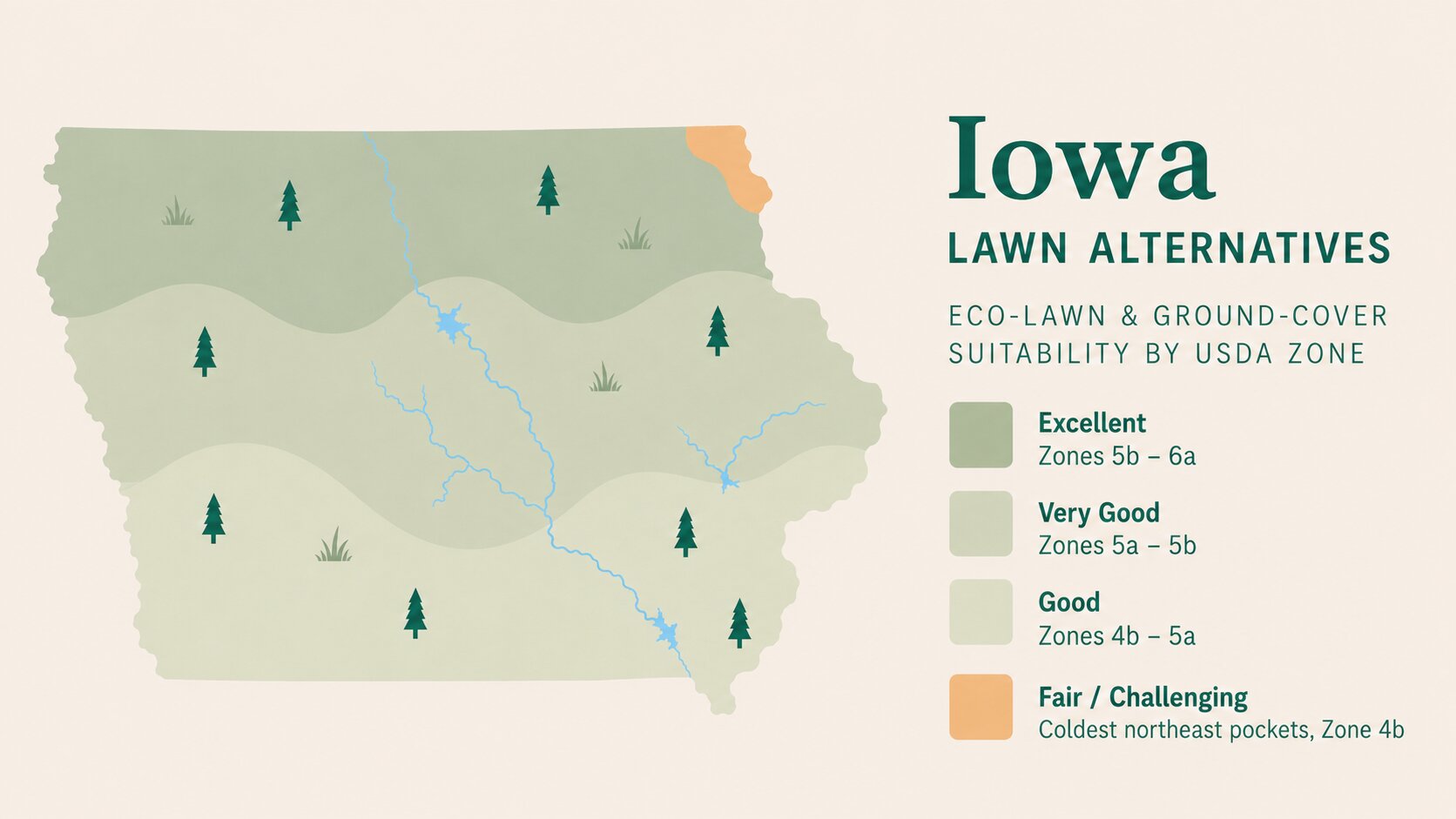
Iowa sits in USDA zones 4b–6a. Below: the low-input lawns that genuinely suit the state’s climate, an honest note on what doesn’t, and where to go next — all matched to verified species data.
Know your zone first
Iowa is cold-continental prairie. Per the 2023 USDA Plant Hardiness Zone Map and Iowa State University Extension, nearly all of the state is zone 5 — the northern half 5a and the southern half 5b — with 4b pockets in the far-northeast Driftless region and small 6a areas in the far south. Des Moines sits in 5b.
Winters are cold and snowy, summers hot and humid. That makes cold-hardy cool-season species the backbone here — while Iowa’s prairie heritage and drier western soils give one warm-season native a real place too.
| Part of state | USDA zones | Representative cities |
|---|---|---|
| Far NE / Driftless | ~4b–5a | Decorah, Waukon, Upper Mississippi bluffs |
| Northern & NW Iowa | ~5a | Sioux City, Mason City, Fort Dodge |
| Central & southern | ~5b | Des Moines, Ames, Davenport, Council Bluffs |
| Far south corners | ~6a | Keokuk, Fort Madison |
Zone data: 2023 USDA Plant Hardiness Zone Map (planthardiness.ars.usda.gov); Iowa State University Extension and Outreach (extension.iastate.edu). Species data from our Verified Data Layer.
Low-input lawns that suit Iowa
Honest note: know your season and shade
Buffalograss is a genuine Iowa-region prairie native, but it’s warm-season — green in summer, tan and dormant in spring and fall — and it needs full sun and well-drained ground, so it suits the drier west and south rather than cold northern or shaded yards. For shade and year-round green, lean on cool-season fine fescue, clover and native Pennsylvania sedge instead.
Shop these for your climate
Getting it right here
Cool-season is the backbone. Fine fescue and clover carry most Iowa yards; native Pennsylvania sedge handles the shade under mature trees.
Buffalograss for the right spot. Reserve it for sunny, drier sites in western and southern Iowa, and expect a summer-only green-up.
Time it right. Sow cool-season seed in late summer or early fall; sow warm-season buffalograss in late spring once the soil warms.
Find your exact zone
Look up your ZIP at the USDA Plant Hardiness Zone Map, then match species using our zone reference and planting calendar.
Common questions for Iowa
What USDA zone is Iowa?
Is fine fescue or buffalograss the better choice in Iowa?
What grows well in shade in Iowa?
When should I plant in Iowa?
Plan your Iowa lawn
Nearby & similar-climate states
Planning across the region? Compare lawn-alternative guidance for Illinois, Minnesota, Missouri, Nebraska, Wisconsin.