
Lawn alternatives in Missouri
Missouri straddles the line — cool-season in the north, warm-season in the south, with prairie natives in the mix.
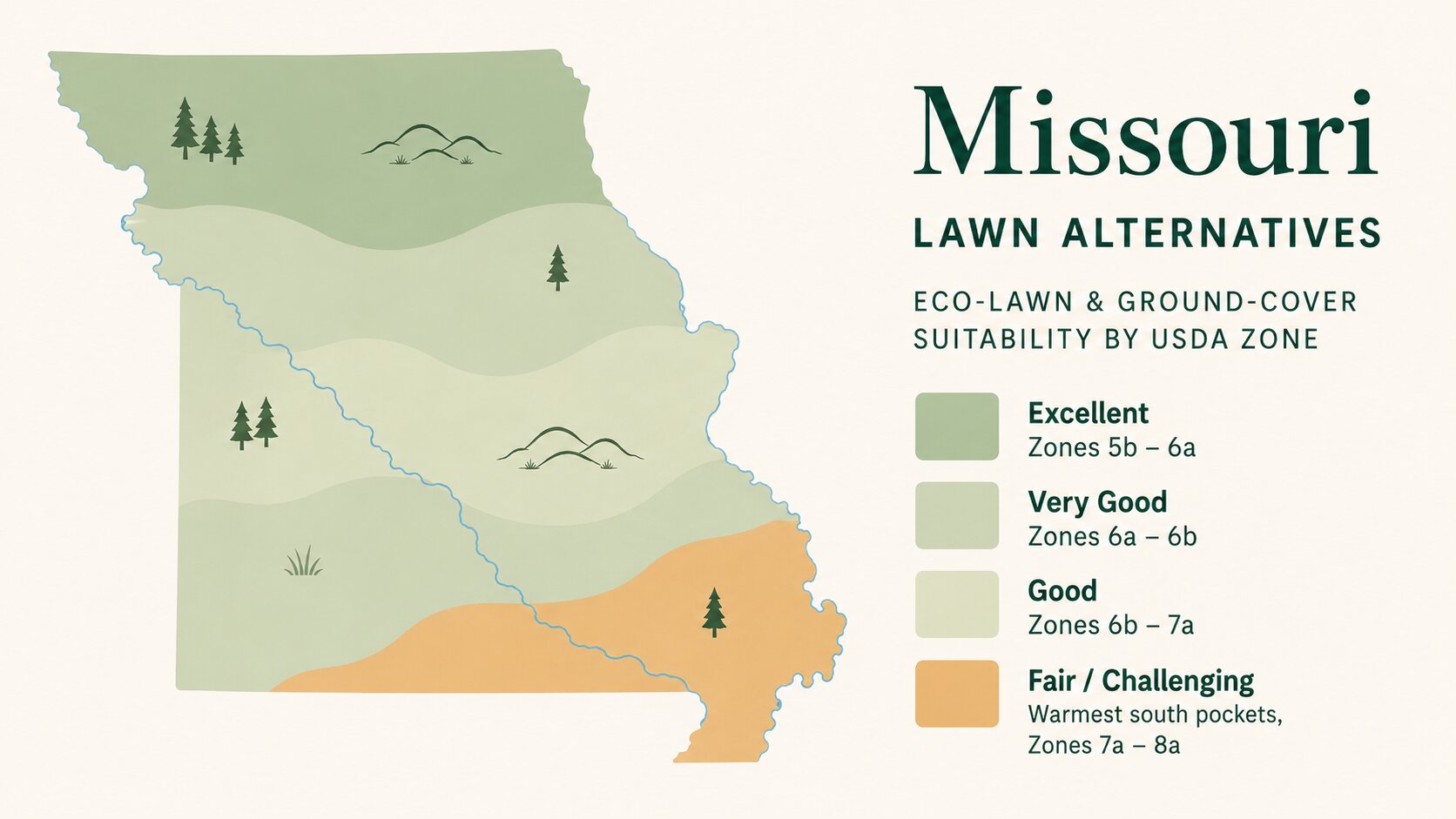
The short version
Missouri sits in USDA zones 5b–8a. Below: the low-input lawns that genuinely suit the state’s climate, an honest note on what doesn’t, and where to go next — all matched to verified species data.
Know your zone first
Missouri sits right on the transition. Per the 2023 USDA Plant Hardiness Zone Map and University of Missouri Extension, the state spans zone 5b in the far north to 8a in the southeastern Bootheel, with most of the state in 6a–6b.
It’s a four-season continental climate: cold winters in the north, hot humid summers, and a near-subtropical feel in the Bootheel. That straddle means both cool-season and warm-season species have a real place, depending on where you are.
| Part of state | USDA zones | Representative cities |
|---|---|---|
| Northern Missouri | ~5b–6a | Maryville, Kirksville, St. Joseph |
| Kansas City & central | ~6a–6b | Kansas City, Columbia, Jefferson City |
| St. Louis & Ozarks | ~6b–7a | St. Louis, Springfield, Joplin |
| Southeast Bootheel | ~7b–8a | Sikeston, Cape Girardeau, Kennett |
Zone data: 2023 USDA Plant Hardiness Zone Map (planthardiness.ars.usda.gov); University of Missouri Extension (extension.missouri.edu). Species data from our Verified Data Layer.
Low-input lawns that suit Missouri
Honest note: match your latitude and site
In the cooler north and in shade, cool-season fescue and clover lead — but fescue goes summer-dormant in the heat. In the sunny, drier west and the warm south, warm-season buffalograss shines (browning outside summer), and the Bootheel is warm enough for warm-season options. Native Pennsylvania sedge handles the shady Ozark woods.
Shop these for your climate
Getting it right here
North vs south, sun vs shade. Lean cool-season in the cooler north and shade; lean warm-season in the sunny west and warm south.
Use the prairie heritage. Buffalograss is a genuine Missouri-region native for dry, sunny sites — just expect a summer-only green-up.
Time it to the species. Sow cool-season seed in fall; sow warm-season buffalograss in late spring.
Find your exact zone
Look up your ZIP at the USDA Plant Hardiness Zone Map, then match species using our zone reference and planting calendar.
Common questions for Missouri
What USDA zone is Missouri?
Is buffalograss a good fit for Missouri?
Do I need cool-season or warm-season species in Missouri?
When should I plant in Missouri?
Plan your Missouri lawn
Find your lawn alternative
Matched to your zone and site.
Nearby & similar-climate states
Planning across the region? Compare lawn-alternative guidance for Arkansas, Illinois, Iowa, Kansas, Kentucky.