
Lawn alternatives in Kentucky
Kentucky sits in the classic turf transition zone — the toughest place to grow grass, and exactly where a forgiving low-input lawn wins.
The short version
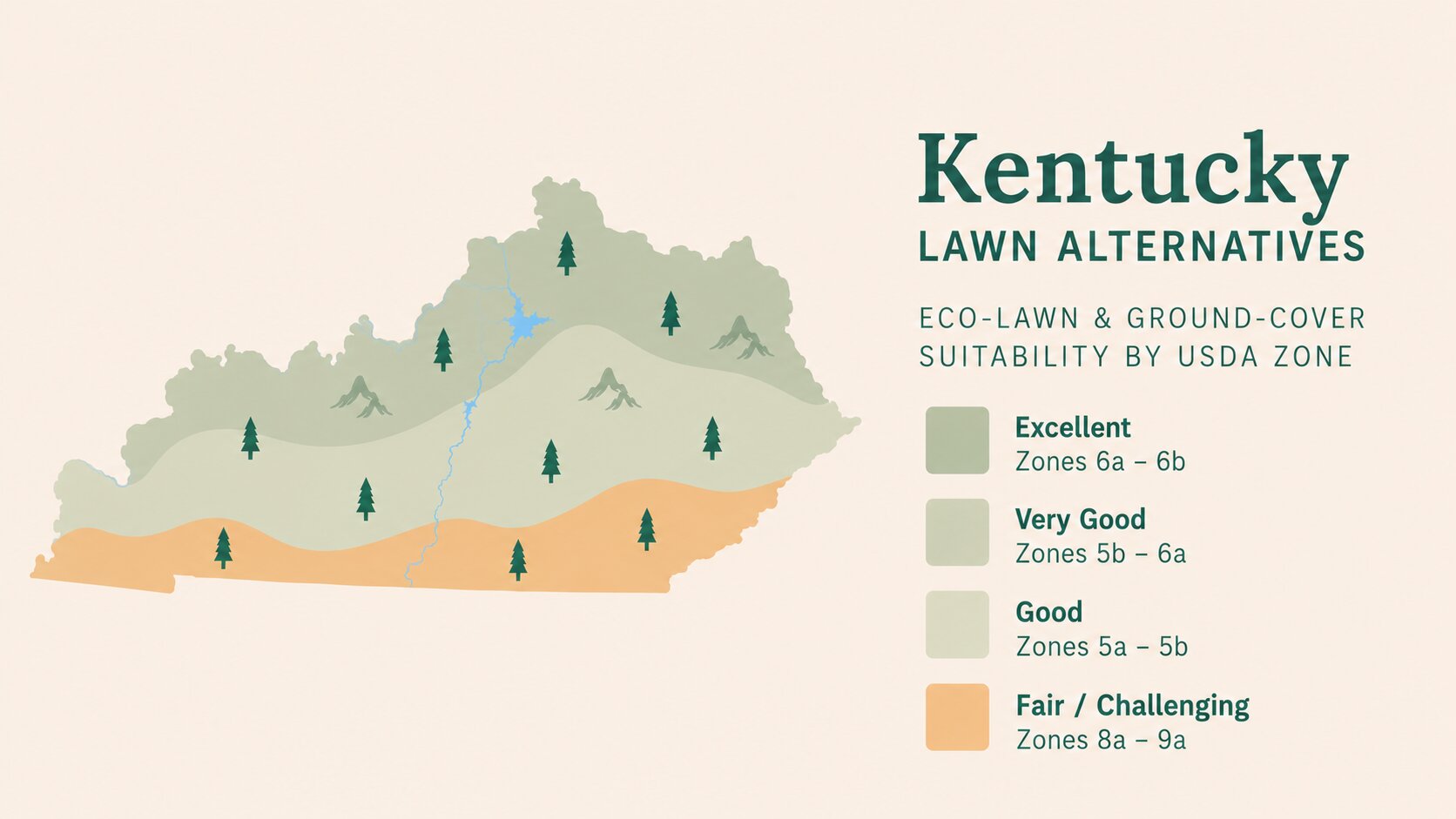
Kentucky sits in USDA zones 6b–7b. Below: the low-input lawns that genuinely suit the state’s climate, an honest note on what doesn’t, and where to go next — all matched to verified species data.
Know your zone first
Kentucky straddles two climates. Per the 2023 USDA Plant Hardiness Zone Map and University of Kentucky Extension, the state spans zone 6b in the northern Bluegrass and eastern mountains to 7b in the Jackson Purchase — Louisville and Lexington sit in 7a, where most of the state falls.
It’s a humid transition zone: hot, humid summers meet variable continental winters. Cool-season lawns struggle through the summer heat while warm-season grasses brown in winter — which is precisely where adaptable, low-input species shine.
| Part of state | USDA zones | Representative cities |
|---|---|---|
| Eastern mountains | ~6a–6b | Appalachian foothills and valleys |
| Northern Bluegrass | ~6b | Frankfort, Covington, northern KY |
| Central corridor | ~7a | Louisville, Lexington, Bowling Green |
| Southern & western | ~7a–7b | Jackson Purchase, Paducah, Murray |
Zone data: 2023 USDA Plant Hardiness Zone Map (planthardiness.ars.usda.gov); University of Kentucky Cooperative Extension (uky.edu). Species data from our Verified Data Layer.
Low-input lawns that suit Kentucky
Honest note: summer dormancy is normal here
In Kentucky’s transition-zone summers, cool-season lawns often go brown and dormant during hot, dry spells — that’s survival, not failure. A low-input lawn rides this out better than thirsty turf. Warm-season buffalograss, by contrast, prefers the drier plains over humid Kentucky.
Shop these for your climate
Getting it right here
Don’t fight the transition zone. Lean into adaptable, forgiving species and accept some summer dormancy rather than chasing high-input turf.
Mind drainage and clay. Much of Kentucky’s clay holds cold and water — improve drainage, especially for thyme.
Time it to the season. Sow cool-season clover and fescue in early fall; the southern Purchase warms enough for warm-season options in late spring.
Find your exact zone
Look up your ZIP at the USDA Plant Hardiness Zone Map, then match species using our zone reference and planting calendar.
Common questions for Kentucky
What USDA zone is Kentucky?
What does “transition zone” mean for Kentucky lawns?
Does Kentucky’s soil affect planting?
When should I plant in Kentucky?
Plan your Kentucky lawn
Find your lawn alternative
Matched to your zone and site.
Nearby & similar-climate states
Planning across the region? Compare lawn-alternative guidance for Illinois, Indiana, Ohio, Tennessee, Virginia.