
Lawn alternatives in Kansas
This is buffalograss country. On the Kansas prairie, a native no-mow lawn isn't a novelty — it's the natural choice.
The short version
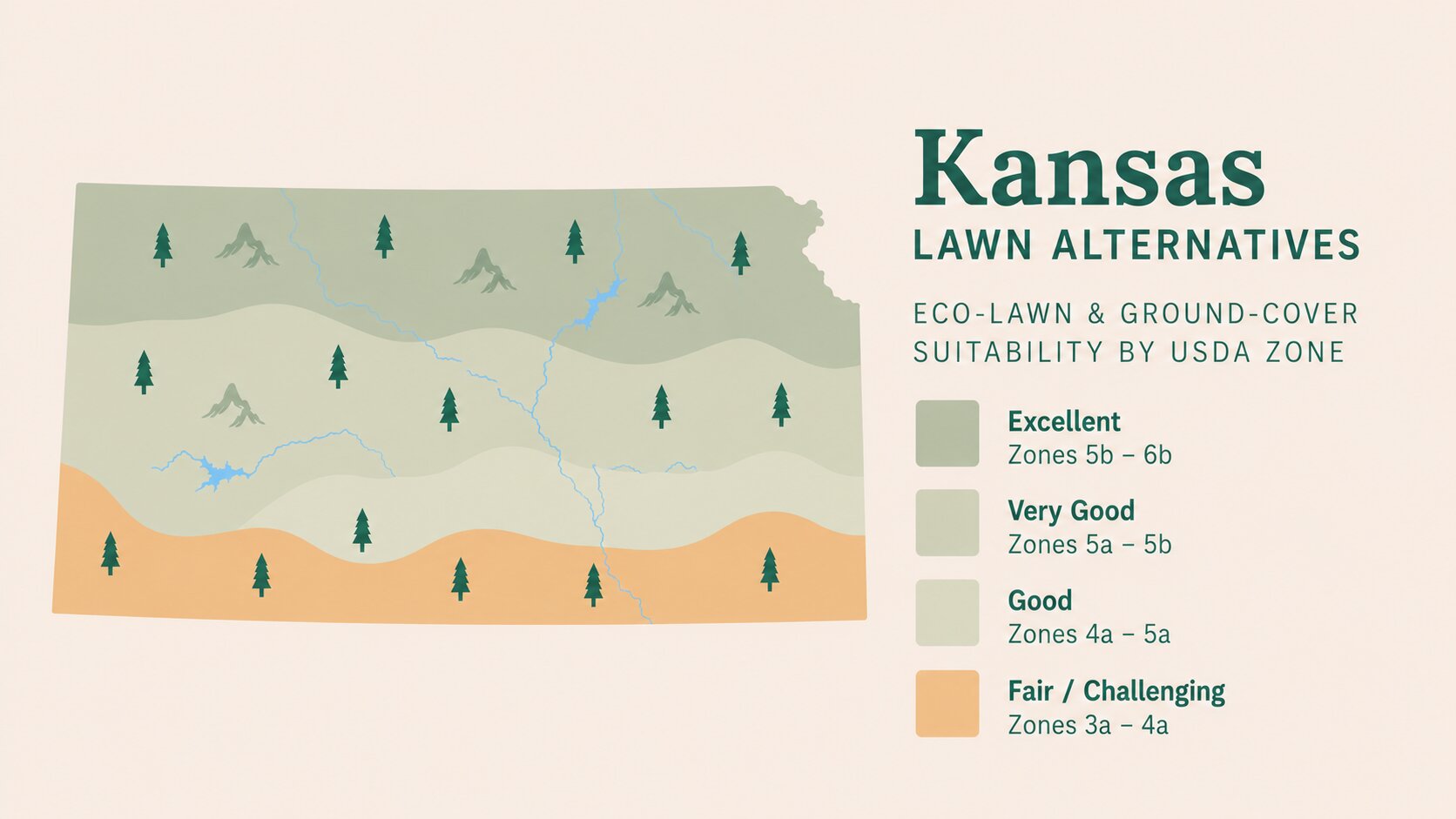
Kansas sits in USDA zones 5b–7a. Below: the low-input lawns that genuinely suit the state’s climate, an honest note on what doesn’t, and where to go next — all matched to verified species data.
Know your zone first
Kansas is Great Plains through and through. Per the 2023 USDA Plant Hardiness Zone Map and K-State Research and Extension, the state spans zone 5b in the far north and northwest to 7a around Wichita and the southeast, with most of the state in 6a–6b.
The defining feature isn’t winter cold — it’s the west-to-east moisture gradient. The semi-arid, windy High Plains in the west give way to a wetter, more humid southeast. That gradient, more than the zone number, decides what thrives.
| Part of state | USDA zones | Representative cities |
|---|---|---|
| Northwest / High Plains | ~5b–6a | Goodland, Colby, Garden City |
| North-central & central | ~6a–6b | Salina, Hays, Manhattan |
| Northeast / KC metro | ~6b | Kansas City, Lawrence, Topeka |
| South-central & SE | ~6b–7a | Wichita, Hutchinson, Pittsburg |
Zone data: 2023 USDA Plant Hardiness Zone Map (planthardiness.ars.usda.gov); K-State Research and Extension (ksre.k-state.edu). Species data from our Verified Data Layer.
Low-input lawns that suit Kansas
Honest note: let the moisture gradient guide you
In the dry, sunny west and center, buffalograss and creeping thyme give you a real lawn on a fraction of the water. In the wetter east and in shade, cool-season fine fescue, clover and native Pennsylvania sedge do better. Remember buffalograss is warm-season — lush green in summer, tan and dormant in spring and fall.
Shop these for your climate
Getting it right here
West vs east. Lead with drought-tough natives in the semi-arid west; lean cool-season in the wetter, shadier east.
Buffalograss is the headline. For sunny Kansas yards it’s hard to beat — just expect a summer-only green-up and give it full sun.
Time it right. Sow warm-season buffalograss in late spring; sow cool-season fescue and clover in early fall.
Find your exact zone
Look up your ZIP at the USDA Plant Hardiness Zone Map, then match species using our zone reference and planting calendar.
Common questions for Kansas
What USDA zone is Kansas?
Does Kansas split east-west rather than north-south?
Is buffalograss really the best choice for Kansas?
When should I plant in Kansas?
Plan your Kansas lawn
Find your lawn alternative
Matched to your zone and site.
Nearby & similar-climate states
Planning across the region? Compare lawn-alternative guidance for Colorado, Missouri, Nebraska, Oklahoma.