
Lawn alternatives in New Hampshire
From the White Mountains to the Seacoast, New Hampshire is cool New England — cold-hardy, cool-season lawn country.
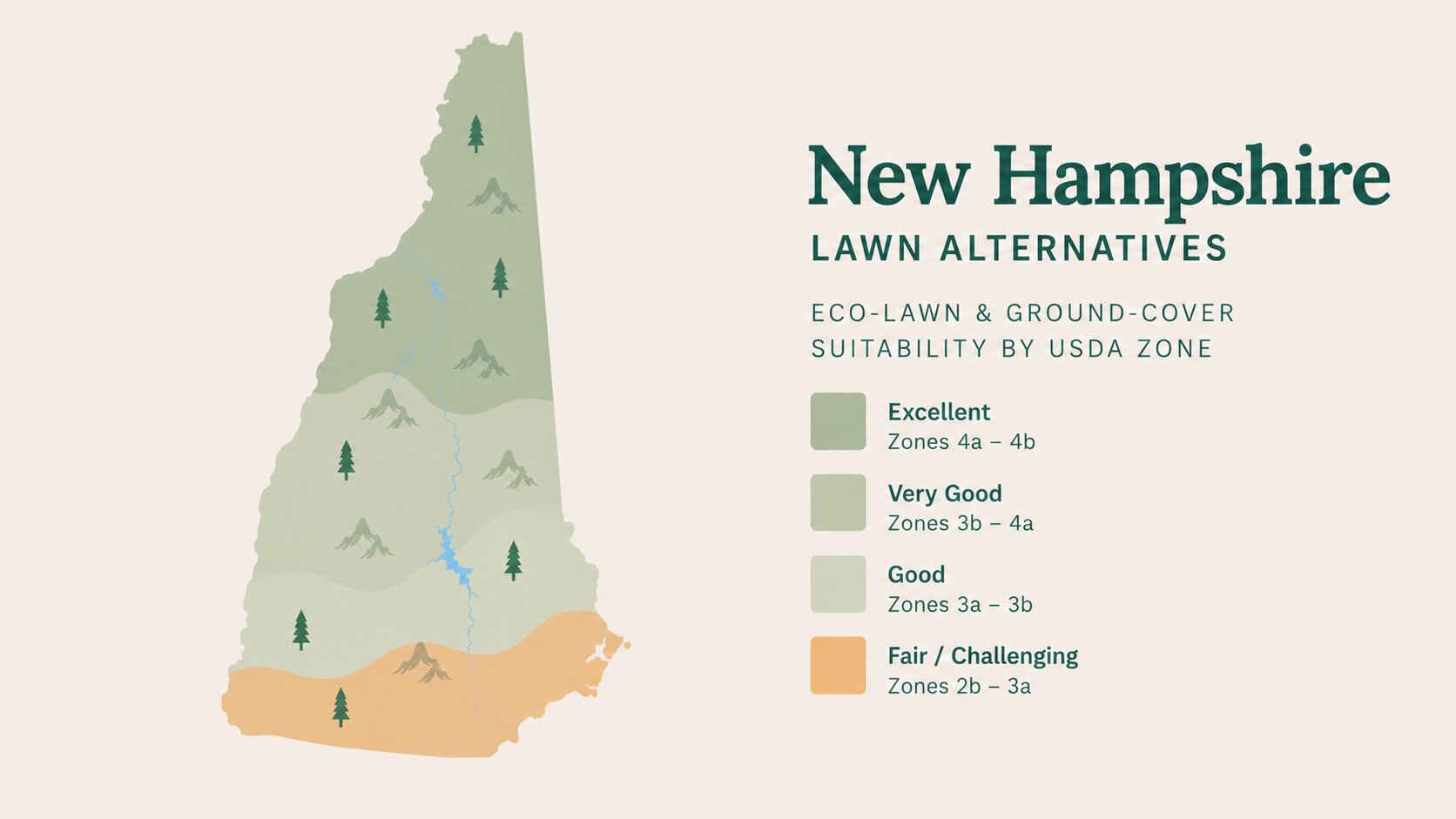
The short version
New Hampshire sits in USDA zones 3b–6b. Below: the low-input lawns that genuinely suit the state’s climate, an honest note on what doesn’t, and where to go next — all matched to verified species data.
Know your zone first
New Hampshire runs cold to mild north-to-south. Per the 2023 USDA Plant Hardiness Zone Map and UNH Extension, the state spans zone 3b in the White Mountains and far north to 6b on the southeastern coast — Concord sits in 5b, Manchester and the Seacoast around 6a.
It’s a cool-to-cold New England climate: cold, snowy winters (severe in the mountains), warm humid summers, and a short season up north. That makes cold-hardy cool-season species the clear choice.
| Part of state | USDA zones | Representative cities |
|---|---|---|
| White Mountains & North Woods | ~3b–4b | Mount Washington, Berlin, Lancaster |
| Lakes Region & central | ~4b–5b | Laconia, Plymouth, Lake Winnipesaukee |
| Merrimack Valley / Monadnock | ~5a–5b | Concord, Keene |
| Southern tier & Seacoast | ~5b–6b | Manchester, Nashua, Portsmouth, Hampton |
Zone data: 2023 USDA Plant Hardiness Zone Map (planthardiness.ars.usda.gov); UNH Extension (extension.unh.edu). Species data from our Verified Data Layer.
Low-input lawns that suit New Hampshire
Honest note: cool-season only here
New Hampshire’s cold winters and short northern seasons rule out warm-season species — buffalograss and dichondra won’t establish, especially up in the mountains. Lean entirely on cool-season fescue, clover and native sedge, and choose the hardiest zone-3 options for the high country.
Shop these for your climate
Getting it right here
North vs south. The cold White Mountains and North Woods need the hardiest cool-season species; the milder south and Seacoast open up the full palette plus thyme.
Sow in the New England window. Late summer to early fall is ideal; the northern season is short, so don’t wait.
Shade is well covered. Native Pennsylvania sedge and fine fescue handle shade under New Hampshire’s trees.
Find your exact zone
Look up your ZIP at the USDA Plant Hardiness Zone Map, then match species using our zone reference and planting calendar.
Common questions for New Hampshire
What USDA zone is New Hampshire?
Does the north need different species than the south?
When should I plant in New Hampshire?
What grows well in shade in New Hampshire?
Plan your New Hampshire lawn
Find your lawn alternative
Matched to your zone and site.
Nearby & similar-climate states
Planning across the region? Compare lawn-alternative guidance for Maine, Massachusetts, Vermont.