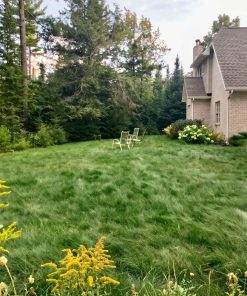


Description
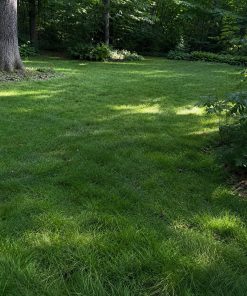
RootNative is a premium no-mow native grass lawn seed blending Buffalograss (Bouteloua dactyloides), Blue Grama (Bouteloua gracilis), Sideoats Grama (Bouteloua curtipendula), and Sheep’s Fescue (Festuca ovina) — the lowest-maintenance lawn seed available. Mow 0–3 times per year or never. No irrigation after establishment. No synthetic fertiliser. No regular maintenance schedule. These four native and drought-adapted grasses evolved on the Great Plains to sustain themselves on rainfall alone — and once established, that is exactly what they do. Non-GMO, USA-grown across Zones 5–9. Full sun only.
RootNative Seed Specifications
| Species | Common Name | Origin | Role in Mix | Height unmowed |
|---|---|---|---|---|
| Bouteloua dactyloides | Buffalograss | Native — Great Plains | Primary ground cover; dense, fine-bladed, self-spreading via stolons; naturally stays at 4–6 in unmowed; highest drought tolerance of any North American turfgrass; blue-green colour | 4–6 in |
| Bouteloua gracilis | Blue Grama | Native — Great Plains / Southwest | Ornamental seed heads — distinctive eyelash-shaped seed heads June–September; adds textural interest and wildlife seed value; fine-bladed, clumping; extreme drought tolerance | 6–12 in at bloom |
| Bouteloua curtipendula | Side-Oats Grama | Native — Great Plains / Central US | Structural height and visual interest; distinctive oat-like seed heads hanging in rows along the stem; important wildlife grass seed source; tolerates a wider range of soils than the other species | 8–24 in at bloom |
| Festuca ovina | Sheep’s Fescue | Cool-season — adapted to dry, low-fertility soils | Soil stabilisation and cool-season complement; provides green coverage during spring and autumn when warm-season species are dormant; excellent drought tolerance; low-growing clumping habit | 4–8 in |
Important — establishment timeline: Native warm-season grasses establish significantly more slowly than cool-season grasses. RootNative requires two full growing seasons for complete coverage. Seed in late spring only (when soil reaches 60°F). Do not expect the same first-season fill as fine fescue or clover products. Patience is required — the result is a permanent, genuinely self-sustaining native lawn.
Why Choose RootNative as Your No-Mow Low-Maintenance Lawn
Most low-maintenance lawn claims are relative — fine fescue still needs occasional mowing, clover still needs some water during establishment, even no-mow mixes require a cut here and there. RootNative is different. Buffalograss naturally tops out at 4–6 inches without any mowing whatsoever — the USDA documents it as the only grass native to the North American Great Plains that maintains a lawn-height appearance with zero mowing. University of Nebraska Extension confirms established Buffalograss lawns survive summers with zero supplemental irrigation in Zones 5–8. No other lawn seed on this site makes both of those claims simultaneously. It requires no fertiliser because prairie grasses evolved in low-nitrogen soils and are actively harmed by nitrogen applications — fertilising them causes them to thin and decline rather than thrive.
The low-maintenance case is made by the biology of the species — but RootNative also delivers ecological value that no amount of lawn management can replicate with non-native grasses. Blue Grama’s distinctive eyelash-shaped seed heads provide winter seed for ground-feeding birds. Side-Oats Grama’s oat-like heads attract finches and sparrows through autumn. Sheep’s Fescue extends the green season into spring and autumn when the warm-season species are dormant. You get a self-sustaining lawn that also functions as wildlife habitat — not as a trade-off, but as an inherent property of growing native species.
The deep root systems of these native species — Buffalograss roots can reach 6 feet — mean that once established, they access soil moisture that surface-rooted cool-season grasses cannot reach. Sheep’s Fescue adds a cool-season component that provides green ground coverage in early spring and late autumn when the warm-season grasses are dormant — extending the visual season of the lawn and stabilising soil through the shoulder seasons. University of Nebraska Extension documents established Buffalograss lawns as surviving summers with zero supplemental irrigation across Zones 5–8.
Best Uses for RootNative Native Grass Seed
| Application | Performance | Notes |
|---|---|---|
| Drought-proof lawn — no irrigation | Excellent | The defining advantage. Survives on 10–15 inches annual rainfall once established. University of Nebraska Extension documents zero supplemental irrigation required in Zones 5–8. No other lawn seed on this site matches this drought tolerance. |
| Native wildlife habitat lawn | Excellent | All three species are native North American grasses providing genuine wildlife value — seed for ground-feeding birds, habitat structure for native pollinators and small mammals. Cannot be replicated with non-native species. |
| Great Plains states — Zones 5–8 | Excellent | Kansas, Nebraska, Oklahoma, Colorado, Texas Panhandle, South Dakota, Iowa, Missouri — this is where these grasses evolved. Outperforms any non-native grass in these states for low-input performance. |
| No-mow or low-mow lawn — Zones 5–9 | Excellent | Buffalograss tops out at 4–6 inches with zero mowing — the only North American native grass that maintains a lawn-height appearance unmowed. Mow 0–3 times per year if a tidy appearance is preferred, or leave entirely. No fertiliser ever. No irrigation after the first season. The most genuinely low-maintenance lawn seed available. |
| Northeast and Pacific Northwest — Zones 3–5 humid | Not suitable | Buffalograss and Blue Grama require warm summers and relatively dry conditions to thrive. In high-humidity, high-rainfall northeastern states they establish poorly and thin over time. For cool humid zones see ShadeCraft Fine Fescue or the clover range. |
| Shade sites — under 6 hours sun | Not suitable | All three species are full-sun prairie grasses. They fail in shade. RootNative requires a minimum of 6 hours of direct sun per day. |
| Heavy clay soils | Very Good | All three species evolved in heavy clay prairie soils and tolerate compacted conditions better than most lawn grasses. Side-Oats Grama is the most clay-tolerant of the three. Avoid waterlogged sites. |
Zone & Climate Compatibility
| Zone / Region | Performance | Notes |
|---|---|---|
| Zone 5–7 Great Plains (primary target) | Excellent | Kansas, Nebraska, Oklahoma, Colorado, South Dakota, Iowa, Missouri — the native range of all three species. Maximum drought tolerance, full wildlife value, zero irrigation once established. Seed late May–June when soil reaches 60°F. |
| Zone 7–9 South / Southwest | Excellent | Texas, New Mexico, Arizona (higher elevation), northern Mexico. Buffalograss is evergreen in Zone 8–9. Warm summers accelerate establishment. Seed April–May. The correct warm-season native lawn for the south and southwest. |
| Zone 5–6 transitional | Very Good | Buffalograss goes winter-dormant (brown) in Zones 5–6 from October to April. This is normal and expected — it greens up reliably each May. Some buyers in these zones prefer evergreen fine fescue for winter appearance. |
| Zone 3–5 humid Northeast/PNW | Not suitable | High humidity and high annual rainfall favour disease and outcompeting cool-season weeds over these warm-season prairie species. Performance is unreliable in the humid northeast and Pacific Northwest. |
How to Plant RootNative — The Low-Maintenance Native Lawn
Timing is critical. Native warm-season grasses must be seeded in late spring only — when soil temperature reaches 65°F and after the last frost. In most Zone 5–7 locations, this means late May through June. Do not attempt autumn seeding — the seeds will not germinate in cooling soils. Germination takes 14–30 days, and full coverage takes two growing seasons.
- Kill or suppress existing vegetation. Native grasses compete poorly with established cool-season weeds and grass in the first season. Either smother existing vegetation with cardboard mulch the autumn before seeding, or apply a non-selective herbicide 2–3 weeks before seeding and rake off the dead material.
- Prepare a firm, smooth seedbed. Rake to remove debris. Firm the soil lightly — native grass seed germinates best in firm, direct soil contact. Do not loosen soil deeply as this brings weed seeds to the surface.
- Broadcast at the surface. Sow per 1,000 sq ft. Do not bury — all three species require light surface contact. Buffalograss burs in particular need to rest on the soil surface.
- Tamp lightly for soil contact. Use a lawn roller or firm tamp. This is more important for native grasses than for cool-season species — good seed-to-soil contact significantly improves germination rates.
- Water consistently for the first 6 weeks. Keep the surface moist until germination (14–30 days) and continue watering lightly through the first growing season. After the first full season, native grasses are self-sustaining on natural rainfall in Zones 5–8.
- Expect slow establishment. Year one: scattered plants, incomplete coverage. Year two: spreading stolons (Buffalograss), filling coverage, first full-stand appearance. Do not give up in year one — this is normal.
- Mow once in late autumn. Cut to 3–4 inches in November before winter dormancy. This removes accumulated thatch and prepares the stand for spring green-up.
Once established — typically end of year two — RootNative requires no further inputs. No mowing schedule. No irrigation. No fertiliser. The lawn maintains itself on rainfall and sunlight as it has done on the Great Plains for thousands of years. Full establishment guide at our Alternative Lawn Guide → and No-Mow Lawn Guide →
Sources
- University of Nebraska Extension — Buffalograss lawn establishment and drought tolerance: extension.unl.edu
- USDA PLANTS — Bouteloua dactyloides, B. gracilis, B. curtipendula native range and ecology: plants.usda.gov
- Kansas State University Extension — Native grass lawns for the Great Plains: ksre.k-state.edu
- Colorado State University Extension — Blue Grama and Buffalograss lawn management: extension.colostate.edu
- ASPCA Animal Poison Control — Bouteloua spp. not listed as toxic: aspca.org
Related guides:
Related products: