Lawn alternatives in Wyoming
Cold, high and dry — Wyoming is cool-season lawn country where water-wise choices and native buffalograss earn their place on the plains.
The short version
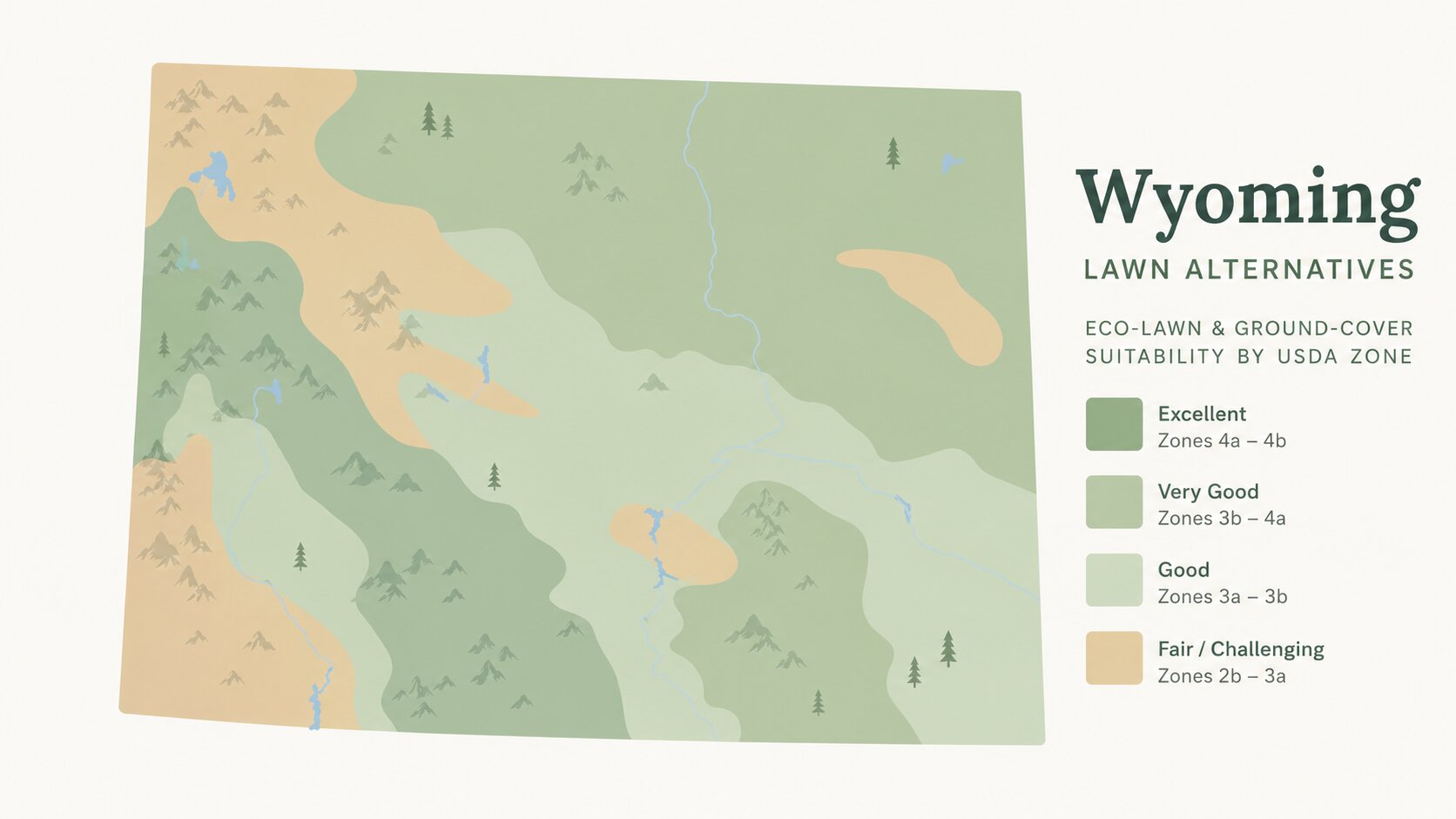
Wyoming sits in USDA zones 3b–6a. Below: the low-input lawns that genuinely suit the state’s climate, an honest note on what doesn’t, and where to go next — all matched to verified species data.
Know your zone first
Wyoming is cold and high. Per the 2023 USDA Plant Hardiness Zone Map and University of Wyoming Extension, the state spans zone 3b in the high Teton valleys to 6a in the warmest southwest basins — Cheyenne sits around 5a–5b, Casper in 5a, Jackson around 4a.
It’s a cold, high-elevation, semi-arid climate: very cold winters, a short season, strong wind and sun, and little moisture. That makes cold-hardy cool-season species the backbone, with water-wise choices doing a lot of the work.
| Part of state | USDA zones | Representative cities |
|---|---|---|
| Western Valleys & Teton Country | ~3b–4b | Jackson, Pinedale, Afton, Dubois |
| Central Basins & Plateaus | ~4a–5b | Casper, Riverton, Lander |
| Northern Plains & Bighorn Foothills | ~4a–5a | Sheridan, Buffalo, Gillette, Cody |
| Southeast High Plains & Southwest | ~4b–6a | Cheyenne, Laramie, Rock Springs, Green River |
Zone data: 2023 USDA Plant Hardiness Zone Map (planthardiness.ars.usda.gov); University of Wyoming Extension (uwyo.edu/uwe). Species data from our Verified Data Layer.
Low-input lawns that suit Wyoming
Honest note: cold, dry, and water-wise
Wyoming is cold, high and dry, so cool-season species lead and water-wise choices matter. Fine fescue and clover work statewide (with some irrigation in the dry climate), creeping thyme suits the windy, sunny sites, and on the warmer, drier southeast and eastern high plains native buffalograss is a real low-water lawn — though it’s marginal in the cold high country and short-season Teton valleys, browning to tan outside summer. Warm-season dichondra can’t survive the winters here.
Shop these for your climate
Getting it right here
High country vs plains. The cold Teton valleys and high basins need the hardiest cool-season species; the warmer, drier eastern plains open the door to low-water buffalograss.
Lean low-water. In a semi-arid state, buffalograss and creeping thyme give the most lawn for the least water, and cool-season species should be irrigated efficiently.
Sow early. The season is short and windy — get cool-season seed down in late summer or early spring.
Find your exact zone
Look up your ZIP at the USDA Plant Hardiness Zone Map, then match species using our zone reference and planting calendar.
Common questions for Wyoming
What USDA zone is Wyoming?
Does high country need different species than the plains in Wyoming?
Is Wyoming a low-water state overall?
When should I plant in Wyoming?
Plan your Wyoming lawn
Find your lawn alternative
Matched to your zone and site.
Nearby & similar-climate states
Planning across the region? Compare lawn-alternative guidance for Colorado, Idaho, Montana, Nebraska, South Dakota.