
Lawn alternatives in New Mexico
High desert and elevation-driven — in New Mexico water comes first, and the lowest-water natives lead.
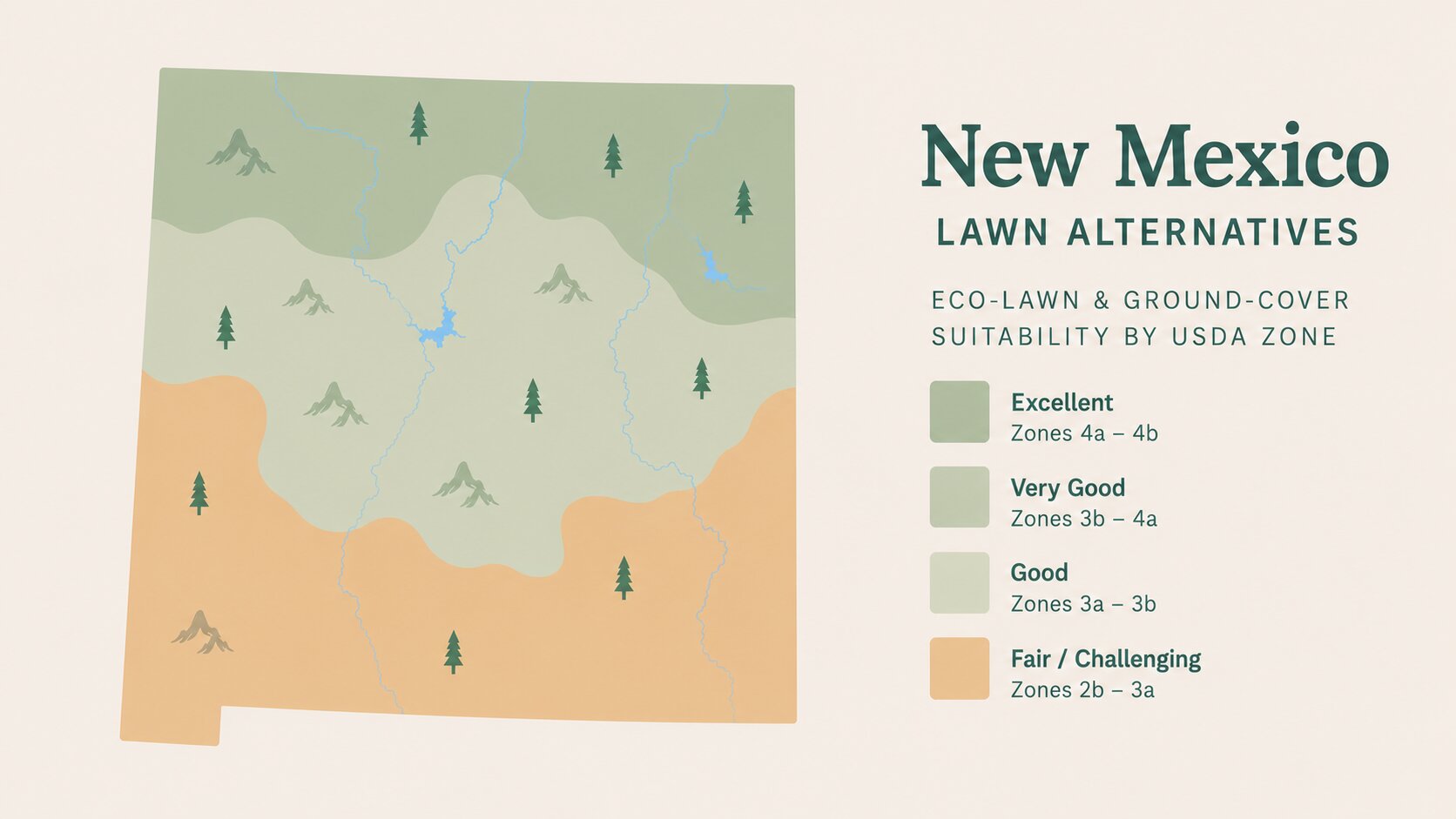
The short version
New Mexico sits in USDA zones 5a–8b. Below: the low-input lawns that genuinely suit the state’s climate, an honest note on what doesn’t, and where to go next — all matched to verified species data.
Know your zone first
New Mexico is shaped by elevation. Per the 2023 USDA Plant Hardiness Zone Map and New Mexico State University Extension, the state spans zone 5a in the northern mountains to 8b in the southern borderlands — Santa Fe sits around 6b–7a, Albuquerque around 7a–8a, Las Cruces 8a–8b.
It’s an arid-to-semi-arid high-desert climate: low humidity, strong sun, big day–night swings, and little rain. As in Arizona and Nevada, water — not the zone number — is the real constraint, so the lowest-water options come first.
| Part of state | USDA zones | Representative cities |
|---|---|---|
| Northern mountains / high mesas | ~5a–6b | Taos, Santa Fe, Las Vegas (NM) |
| Central Rio Grande | ~6b–8a | Albuquerque, Rio Rancho, Socorro |
| Southern valleys / borderlands | ~7b–8b | Las Cruces, Deming, Alamogordo |
| Eastern plains / NW plateau | ~5b–8a | Roswell, Clovis, Farmington, Gallup |
Zone data: 2023 USDA Plant Hardiness Zone Map (planthardiness.ars.usda.gov); New Mexico State University Extension (pubs.nmsu.edu). Species data from our Verified Data Layer.
Low-input lawns that suit New Mexico
Honest note: water comes first in New Mexico
In this arid high desert, even a drought-tolerant lawn needs irrigation to establish, and cool-season fine fescue is especially thirsty here — best kept to the cooler north with careful watering. Lead with the lowest-water natives (buffalograss, creeping thyme), and in the hot, dry south a true xeriscape often beats a planted lawn. Clover is pet-safe but water-hungry, so use it sparingly.
Shop these for your climate
Getting it right here
Match your elevation. The cool north and high mesas suit buffalograss and fescue; the warm southern valleys suit dichondra and thyme.
Lead with low-water options. Buffalograss and creeping thyme give the most lawn for the least water across most of the state.
Time it to the species. Sow warm-season buffalograss and dichondra in late spring; sow cool-season fescue in early fall.
Find your exact zone
Look up your ZIP at the USDA Plant Hardiness Zone Map, then match species using our zone reference and planting calendar.
Common questions for New Mexico
What USDA zone is New Mexico?
Does elevation matter more than latitude in New Mexico?
Do I need low-water species in New Mexico?
When should I plant in New Mexico?
Plan your New Mexico lawn
Find your lawn alternative
Matched to your zone and site.
Nearby & similar-climate states
Planning across the region? Compare lawn-alternative guidance for Arizona, Colorado, Oklahoma, Texas.