
Lawn alternatives in Hawaii
Hawaii is tropical and exceptionally invasion-sensitive — so our mainland lawn palette doesn't apply, and choosing the right species matters more here than anywhere.
The short version
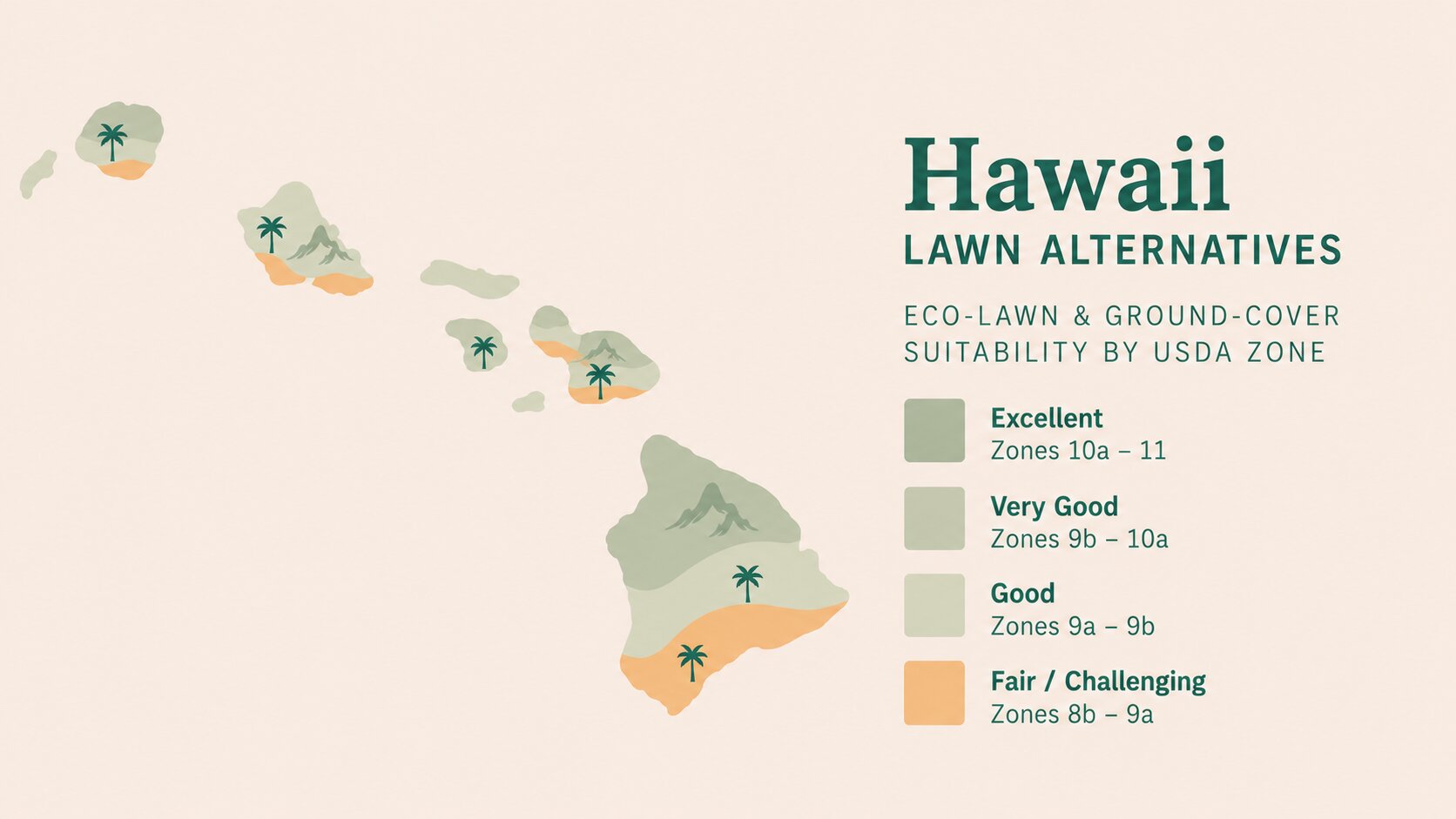
Hawaii sits in USDA zones 9a–13a. Below: the low-input lawns that genuinely suit the state’s climate, an honest note on what doesn’t, and where to go next — all matched to verified species data.
Know your zone first
Hawaii’s zones are driven by elevation, not latitude. Per the 2023 USDA Plant Hardiness Zone Map and the University of Hawaiʻi CTAHR Cooperative Extension, the islands span about zones 9 on the high volcanic slopes to 13 on the warmest coasts — most populated lowlands sit in tropical zones 11–12.
That tropical climate puts Hawaii outside the range of nearly all our temperate and Mediterranean species. Just as importantly, Hawaii is one of the most invasion-vulnerable places on Earth — many common mainland “ground covers” are damaging invasive pests here.
| Part of state | USDA zones | Representative cities |
|---|---|---|
| High-elevation slopes | ~9a–10b | Upper Mauna Kea, Mauna Loa, Haleakalā |
| Lowlands & populated areas | ~11a–12b | Honolulu, Hilo, Kahului, Kailua-Kona |
| Warmest coasts | ~13a | Leeward shorelines |
Zone data: 2023 USDA Plant Hardiness Zone Map (planthardiness.ars.usda.gov); University of Hawaiʻi CTAHR Cooperative Extension (ctahr.hawaii.edu). Species data from our Verified Data Layer.
Low-input lawns that suit Hawaii
Honest note: invasive species come first in Hawaii
This is the one place where “what spreads easily” is a warning, not a selling point. Many vigorous mainland ground covers become destructive invasives on the islands. Before planting anything, check it against Hawaii’s invasive-species lists and the UH CTAHR Extension — and favour island-native, non-invasive ground covers. Our temperate species (fine fescue, clover, thyme, buffalograss) simply aren’t suited to Hawaii’s tropical zones.
Shop these for your climate
Getting it right here
Go local and native. The right answer for a Hawaiian yard is a Hawaii-adapted, non-invasive ground cover — UH CTAHR is the authoritative guide.
Treat invasiveness as the top filter. A plant that “fills in fast” can be exactly the wrong choice here; check before you plant.
Elevation sets your zone. Cool high-elevation gardens differ enormously from warm leeward coasts — match to your specific spot.
Find your exact zone
Look up your ZIP at the USDA Plant Hardiness Zone Map, then match species using our zone reference and planting calendar.
Common questions for Hawaii
What USDA zone is Hawaii?
Does Competitive Lawn sell species suited to Hawaii?
Why does invasiveness matter more in Hawaii than elsewhere?
Where should I actually go for Hawaii-specific planting advice?
Plan your Hawaii lawn
Find your lawn alternative
Matched to your zone and site.
Nearby & similar-climate states
Planning across the region? Compare lawn-alternative guidance for California, Florida, Louisiana, Texas.