
The science under the lawn
How clover fixes nitrogen, why provenance matters, what drought physiology and mycorrhizal networks actually do — explained clearly, cited properly, and honest where the evidence is thin.
Where to start
These pages go a level deeper than the how-to: the mechanisms behind why alternative lawns work. We keep the language plain, cite peer-reviewed and extension sources, and say clearly when a popular claim — like lawn carbon sequestration — is genuinely contested.
What the research actually shows
“Lawn alternatives” is a marketing phrase; the reasons they work are specific, measurable and published. This section explains the biology under the claims — and flags where the evidence is thinner than the internet suggests.
Nitrogen fixation: why clover feeds itself
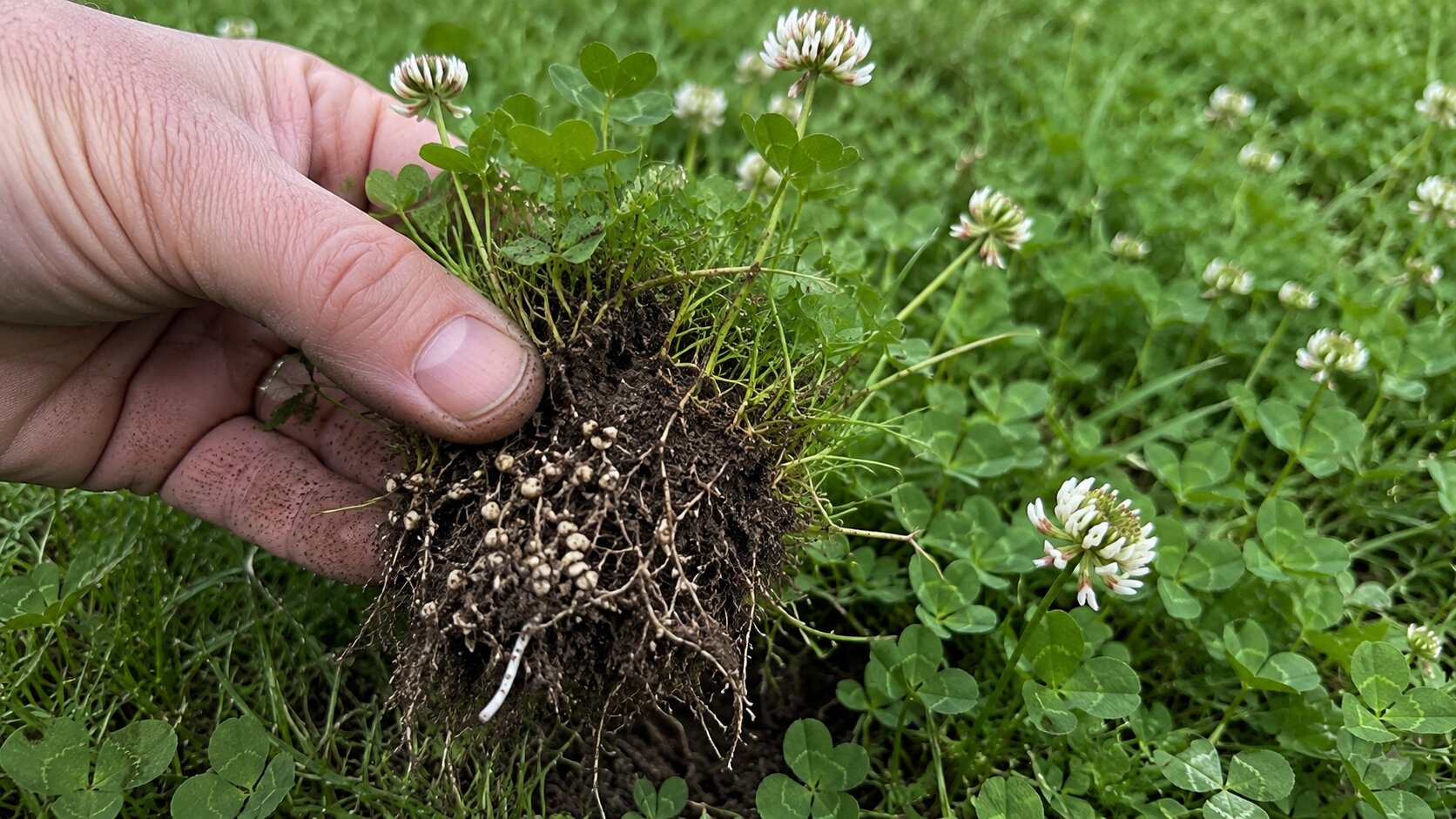
White clover (Trifolium repens) hosts Rhizobium bacteria in its root nodules, which convert atmospheric nitrogen into a form the plant can use. A vigorous stand fixes roughly 100–150 lb of nitrogen per acre per year (University of Georgia Extension, B-1251), which is why a clover lawn needs no synthetic nitrogen and why its grass neighbours green up too as old nodules break down. The catch is soil chemistry: below about pH 6.0 the Rhizobium symbiosis falters, so a soil test is the single best predictor of whether a clover lawn thrives.
Drought physiology: why fine fescue stays green on less
Fine fescues survive drought by avoidance, not luck. University of Minnesota Extension reports they can go up to four weeks without rain before they even need a half-inch of water, and generally prefer drier soil than turf-type grasses. Species differ: Oregon State ranks sheep fescue as the most drought-resistant, ahead of hard, creeping red and Chewings — which is why the toughest low-water mixes lean on sheep and hard fescue.
Germination science: reading a seed label honestly
Two numbers on a seed tag decide what you actually get. Purity and germination multiply into Pure Live Seed (PLS) — the fraction of the bag that is viable seed of the species you paid for — so a cheap bag with low PLS can cost more per living plant than a dearer one. Some species also need cold, moist stratification to break dormancy; skip it and germination stalls no matter how good the seed.
The science behind each lawn
| The claim | The mechanism | Where it applies |
|---|---|---|
| “Feeds itself, no fertilizer” | Rhizobium N-fixation, ~100–150 lb/acre/yr | Clover lawns |
| “Stays green without watering” | Deep roots + drought avoidance | Fine fescue, natives |
| “Supports more pollinators” | Season-long floral resources | Wildflower & bee lawns |
Explore the research
Common questions
How much nitrogen does clover really fix?
A vigorous white clover stand fixes roughly 100–150 lb of nitrogen per acre per year (University of Georgia Extension), enough that a clover lawn needs no synthetic nitrogen — provided soil pH is at or above 6.0.
Why does fine fescue need so little water?
It avoids drought rather than fighting it. UMN Extension finds fine fescues can go up to four weeks without rain before needing water, and they prefer drier soils than conventional turf.
What is “PLS” on a seed label?
Pure Live Seed — purity multiplied by germination. It’s the share of the bag that is actually viable seed of the species named, and the honest way to compare seed prices.
Do eco-lawns store carbon?
Possibly a little, but the home-lawn evidence is thin and mixed once mowing and inputs are counted. We treat carbon storage as an open question, not a headline claim.
- University of Georgia Cooperative Extension. White Clover Establishment and Management Guide (Bulletin 1251).
- University of Minnesota Extension. Planting and maintaining a fine fescue lawn.
- Oregon State University, Beaverturf. The Fine Fescues (drought-resistance ranking).
See it in the field
See how the science plays out in habitat and biodiversity.
Browse the full The Science of Lawn Alternatives section
Choosing & buying
How-to guides
More in this section
- Biodiversity Metrics: How to Tell If Your Lawn Is Actually Working
- Carbon Sequestration Evidence: What Lawns Store
- Dormancy Stratification: Why Some Seeds Wait to Sprout
- Drought Physiology: How Plants Survive Dry Spells
- Ecotype Local Adaptation: Why Seed Origin Matters
- Evapotranspiration: How Plants Move and Cool Water
- Fine Fescue Allelopathy: Does It Really Poison Weeds?
- Germination Testing: Is Your Seed Still Alive?
- Mycorrhizal Networks: The Fungi Beneath Your Lawn
- Phenology: Nature's Calendar and Bloom Timing
- Plant Competition: How Lawns Beat Weeds
- Pollinator Decline: The Evidence and Your Lawn
- Pure Live Seed (PLS) Explained
- Root Depth: Native Grass vs Conventional Lawn
- Soil Microbiome: The Life Beneath Your Lawn
- Strawberry Clover Nitrogen Fixation Explained
- Turf vs Alternatives: Water Use Compared
- Urban Pollinator Studies: What Yards Can Do