
Lawn alternatives in Oregon
Two states in one — the Cascades split Oregon into a mild, wet west and a cold, arid high-desert east.
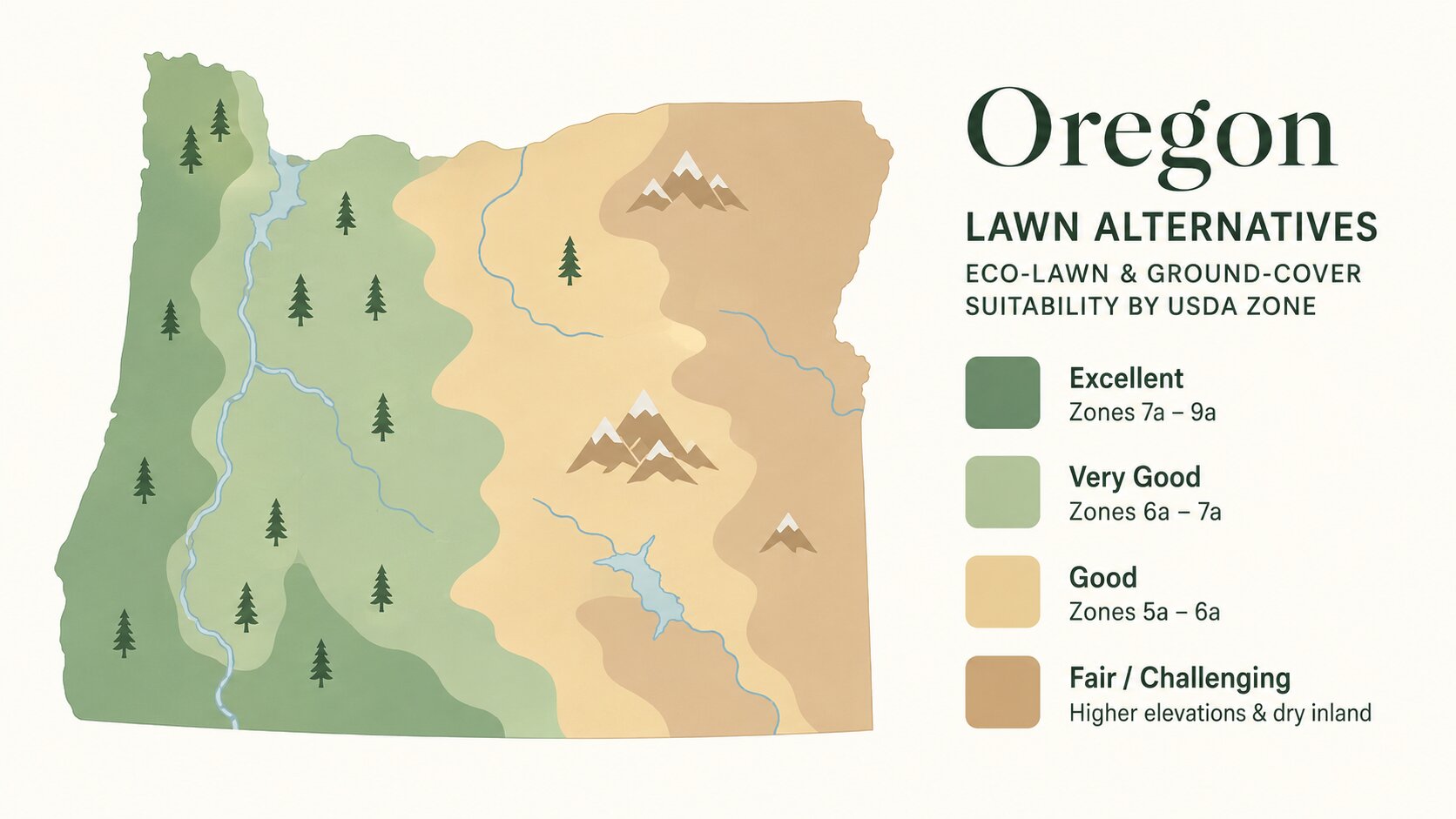
The short version
Oregon sits in USDA zones 4a–10a. Below: the low-input lawns that genuinely suit the state’s climate, an honest note on what doesn’t, and where to go next — all matched to verified species data.
Know your zone first
Oregon is one of the most climatically split states in the country. Per the 2023 USDA Plant Hardiness Zone Map (built by Oregon State University’s PRISM group) and OSU Extension, it spans zone 4a in the eastern mountains to 10a on the south coast — Portland and the Willamette Valley sit around 8a–9a.
The Cascade Range is the dividing line: a mild, moist maritime climate to the west (wet winters, dry summers, long seasons) and a cold, arid high desert to the east (short seasons, little rain). Your side of the mountains changes everything.
| Part of state | USDA zones | Representative cities |
|---|---|---|
| Oregon Coast | ~8b–10a | Astoria, Newport, Coos Bay, Brookings |
| Willamette Valley & Portland | ~8a–9a | Portland, Salem, Eugene, Corvallis |
| Southern Oregon / Rogue Valley | ~7a–9a | Medford, Grants Pass, Ashland |
| Central & Eastern high desert | ~4a–7b | Bend, Pendleton, Baker City, Burns |
Zone data: 2023 USDA Plant Hardiness Zone Map (PRISM, planthardiness.ars.usda.gov); Oregon State University Extension (extension.oregonstate.edu). Species data from our Verified Data Layer.
Low-input lawns that suit Oregon
Honest note: it depends which side of the Cascades you're on
West of the mountains, the mild, moist maritime climate is ideal for cool-season fine fescue and clover, with dry-summer thyme and native sedges for shade. East of the Cascades, it’s cold, arid high desert: fescue’s cold-hardiness still fits, but water-wise buffalograss and thyme become the smart low-water choices. Warm-season dichondra only suits the warmest low valleys.
Shop these for your climate
Getting it right here
West vs east. The mild, wet west is a cool-season paradise; the cold, dry east calls for water-wise natives and irrigation.
Match water to region. Water is abundant west of the Cascades and scarce east — lean low-water east.
Time it to the species. Sow cool-season fescue and clover in fall west of the mountains; sow warm-season buffalograss in late spring in the east.
Find your exact zone
Look up your ZIP at the USDA Plant Hardiness Zone Map, then match species using our zone reference and planting calendar.
Common questions for Oregon
What USDA zone is Oregon?
Does the Cascades matter for planting in Oregon?
Is water availability different across Oregon?
When should I plant in Oregon?
Plan your Oregon lawn
Find your lawn alternative
Matched to your zone and site.
Nearby & similar-climate states
Planning across the region? Compare lawn-alternative guidance for California, Idaho, Nevada, Washington.